
Many businesses are left in the same position again due to the volume of data they are creating, but aren’t able to produce meaningful decisions. Businesses can select the most suitable business analytics strategy and trusted BI data solutions, which will help them in enhancing performance, cutting costs, and achieving better visibility of the business operation. A strong BI platform will also power teams to make faster business decisions with real-time insights, reports, and dashboards.
In order to stay competitive, companies across a wide range of industries currently rely on business information analytics. Having powerful data BI solutions that are able to organize and count complex details promptly is important for a variety of enterprises, ranging from sales forecasting to keeping track of customer behavior. In fact, the global business intelligence adoption rate is about 26% today, reflecting how many organizations are actively using BI tools to enhance decision‑making and competitiveness. There are, however, many business intelligence platforms available; picking the right one to work with can be confusing.
Making decisions based on data is a major factor in growth. Analytics solutions allow companies to track performance, enhance customer journeys, boost efficiency, and gain insight into market trends. Similarly, due to this burgeoning need, the interest in the top AI business intelligence platforms, as well as advanced AI business intelligence platforms in 2026, has also risen, providing features like automation, predictive analytics, and AI-driven insights.
Meanwhile, most organizations need scalable BI & data warehouse services and flexible custom enterprise business intelligence platforms to manage the increasing size of data. To improve reporting, make business decisions, and ensure long-term success, comparing the top business intelligence platforms and selecting one of the best business intelligence platforms can help businesses.
What Is a Business Intelligence Platform?
➔ Understanding Business Intelligence Software
The data in a BI platform is showcased by software that aggregates, manages, examines, and visualizes business data. These platforms convert information into insights, equipping businesses with the tools to make enhanced decisions.
Modern business intelligence systems offer many advantages over traditional reporting systems, including dashboards, real-time analytics, predictive analytics, and AI-powered reporting.
Data BI solutions are used by organizations to:
• Monitor business performance
• Analyze customer behavior
• Improve operational efficiency
• Recognize opportunities and threats
• Support strategic planning
The traditional reporting tools primarily deliver static reports. Today’s business analytics systems deliver dynamic dashboards, up-to-the-minute updates, and sophisticated forecasting tools.
◈ Core Features of a BI Platform
➥ Data Visualization Dashboards
Dashboards show complex data in an easy-to-understand chart, graph, and visual report. Visualization tools help teams catch trends in no time.
➥ Reporting and Analytics
The advanced reporting capability enables organizations to produce tailored marketing, finance, operations, and sales reports.
➥ Real-Time Monitoring
Most of today’s business intelligence analytical tools give real-time updates, so businesses can know what they’re tracking in real-time.
➥ Predictive Analytics
From historical data, machine learning and predictive analytics can forecast future patterns and results.
➥ Data Integration Capabilities
Businesses can link multiple data sources to 1 system with the help of reliable BI & data warehouse services.
➥ AI-Powered Insights
There’s no doubt that artificial intelligence has become common in many top business intelligence platforms now that they’re able to recognize patterns, perform analysis automatically, and suggest actions.
Why Choosing the Right BI Platform Matters
Choosing the right system could cause longer-term issues for running a business. The right business intelligence platforms enhance productivity, fuel growth, and aid in informed decision-making.
⇒ Impact on Business Growth and Decision-Making
✧ Faster Strategic Decisions
Advanced business analytics systems enable companies to be ‘market savvy’ and today have access to data at their fingertips, so that they are quicker to respond to market changes.
✧ Improved Operational Efficiency
The ideal BI platform also streamlines reporting functions and leads to less manual data processing.
✧ Better Customer Insights
Gaining deeper insights into customer preferences, engagement, and purchasing behavior becomes more thorough using this analysis. Businesses can better understand client preferences, purchase habits, and engagement patterns thanks to this data.
✧ Enhanced Forecasting Accuracy
AI business intelligence platforms in 2026 will have even more intelligent forecasting and predictive modeling features.
⊛ Risks of Selecting the Wrong BI Tool
↠ Poor User Adoption
Employers often find it difficult to use the platform due to complicated dashboards and confusing interfaces.
↠ Scalability Issues
Some systems can no longer deal with greater volumes of data or adding additional user needs.
↠ Data Silos
Lack of integration leads to isolating systems and prevents collaboration.
↠ Increased Operational Costs
Data BI solutions that are lacking in terms of strength usually have to be costly to upgrade and take care of.
↠ Limited Reporting Flexibility
Some tools lack customizable features that can be applied to other departments.
Also Read: Benefits of Business Intelligence in Healthcare, Finance, and Retail Industries
Identify Your Business Intelligence Requirements
In any business intelligence comparison, it’s essential to understand the requirements before choosing the best business intelligence platforms.
☸ Define Your Business Goals
➥ Sales Performance Tracking
Track sales, site visitors, and rates of visitors who convert to customers.
➥ Marketing Analytics
Monitor campaign performance and customer engagement.
➥ Financial Reporting
Evaluate costs, profitability, and trends in budgeting.
➥ Customer Behavior Analysis
Know how customers prefer to purchase products and what they are looking for.
➥ Operational Monitoring
Monitor the performance of the supply chain and operational efficiency.
Business intelligence systems have strong business intelligence analytics.
☸ Understand Your Data Sources
Typically, an organization gathers data from several systems.
➥ CRM Systems
Customer relationship management systems have sales and customer data.
➥ ERP Software
ERP Systems (ERPs) are used to store operational and financial information.
➥ Cloud Applications
Value added is created by cloud tools.
➥ Databases and Spreadsheets
Numerous companies are still using spreadsheets as a basis for reporting.
➥ Third-Party Integrations
Reliable BI & data warehouse services help tie outs to other systems seamlessly.
☸ Determine User Needs
➥ Technical Users
The technological teams typically require:
• SQL query support
• Advanced analytics
• Data modeling capabilities
• API access
➥ Non-Technical Users
People who are not technical would prefer to go for:
• Drag-and-drop dashboards
• Self-service reporting
• Simple visualizations
• Easy navigation
Both technical and non-technical users should be supported by custom corporate business intelligence systems.
Key Features to Look for in a Business Intelligence Platform
➞ Data Integration and Connectivity
Any BI data solution needs to be easily accessible to the existing systems.
Important considerations include:
• Cloud compatibility
• On-premise integration
• API support
• Database connectivity
Modern business intelligence platforms should allow integration with various business tools in flexible ways.
➞ Dashboard and Visualization Capabilities
Visualization tools help to comprehend data.
Check for:
• Interactive dashboards
• Mobile-friendly analytics
• Custom reporting
• Dynamic filters
Improved decision-making within teams through good visualization.
➞ Real-Time Analytics
Real-time reporting means that businesses are able to react in a timely manner to changes in situations.
Benefits include:
• Instant operational insights
• Live performance tracking
• Faster problem detection
• Improved customer response times
Advanced business analytics tools automatically update data in real-time.
➞ AI and Predictive Analytics
The future of analytics is being completely transformed by AI.
The top AI business intelligence technologies available now are:
• Machine learning algorithms
• Automated recommendations
• Predictive forecasting
• Smart anomaly detection
When considering AI business intelligence platforms in 2026, there are two main factors that businesses should prioritize: AI-powered automation and predictive capabilities.
Security and Compliance
Data protection is a necessity.
Look for:
• Role-based access control
• Multi-factor authentication
• Data encryption
• Compliance certifications
Regulations like GDPR and HIPAA should be taken into account by any reliable solution for BI & data warehouse services.
➞ Scalability and Performance
Your BI system needs to support the development of your business in the future.
Consider:
• Growing data volumes
• Increasing users
• Multi-location access
• Enterprise-wide deployment
The best business intelligence platforms are created to be scalable over time.
Cloud-Based vs On-Premise BI Platforms
Cloud and on-premise deployment are the two possibilities. The appropriate deployment depends on the needs of the business and security requirements, along with budget and business goals.
✦ Cloud BI Solutions
Many business intelligence platforms are now being adopted in the cloud. Flexibility and speed to deploy are reasons given by many businesses for opting for cloud solutions.
➔ Advantages
( i ) Lower Upfront Costs
Cloud computing lowers the costs of infrastructure. Large investments in hardware and installation can be avoided by the business.
( ii ) Remote Accessibility
Employees are able to view dashboards from anywhere. Collaboration and business productivity are enhanced by remote access.
( iii ) Easy Scalability
Resources can be expanded in a short time in the company. Cloud systems can easily accommodate growing data quantities and users.
➔ Challenges
( i ) Dependency on Internet Connectivity
Excessive reliance on Internet Connectivity. Reliable Internet access is vital for clouds. Slow connectivity can impact the speed of reporting and the availability of the system.
( ii ) Data Privacy Concerns
There are industries where there are specific data security needs. There are precautions to consider with regard to compliance aspects and privacy policies for organizations that deal with sensitive information.
Most of the leading business intelligence BI solutions are now cloud-centric.
✦ On-Premise BI Solutions
On-premises systems are installed within the scope of the organization. These help businesses to be more on top of the requirements for infrastructure, security, etc.
➔ Advantages
( i ) Greater Control Over Data
Organizations own their own infrastructure. This can enable businesses to have more robust internal data governance.
( ii ) Custom Infrastructure Management
Environment customization is possible according to the enterprise’s needs. Advanced customization for more sophisticated enterprise reporting requirements.
➔ Challenges
( i ) Higher Maintenance Costs
The costs of hardware and maintenance are usually greater. Internal IT teams might require more resources related to system management.
( ii ) Complex Implementation
There may be more technical challenges in deployment. On-prem implementations can take longer than cloud solutions.
For more customization options, there are some companies that opt for custom enterprise business intelligence platforms.
Which Deployment Model Is Right for Your Business?
⇒ SMB vs Enterprise Considerations
Cloud solutions may be a preferred choice for small businesses due to cost. For large companies, more sophisticated features such as customization, scalability, and security measures can be necessary.
⇒ Industry-Specific Requirements
Compliance regulations are typically more strict in sectors including government, healthcare, and finance. As per the requirements of the industry, a cloud set-up or on-premise might be chosen.
⇒ Budget and IT Resources
Before deciding on deployment models, it’s important for companies to assess their internal technical capacities.
The proper infrastructure is selected with the assistance of healthy business analytics planning.
Compare Popular Business Intelligence Platforms
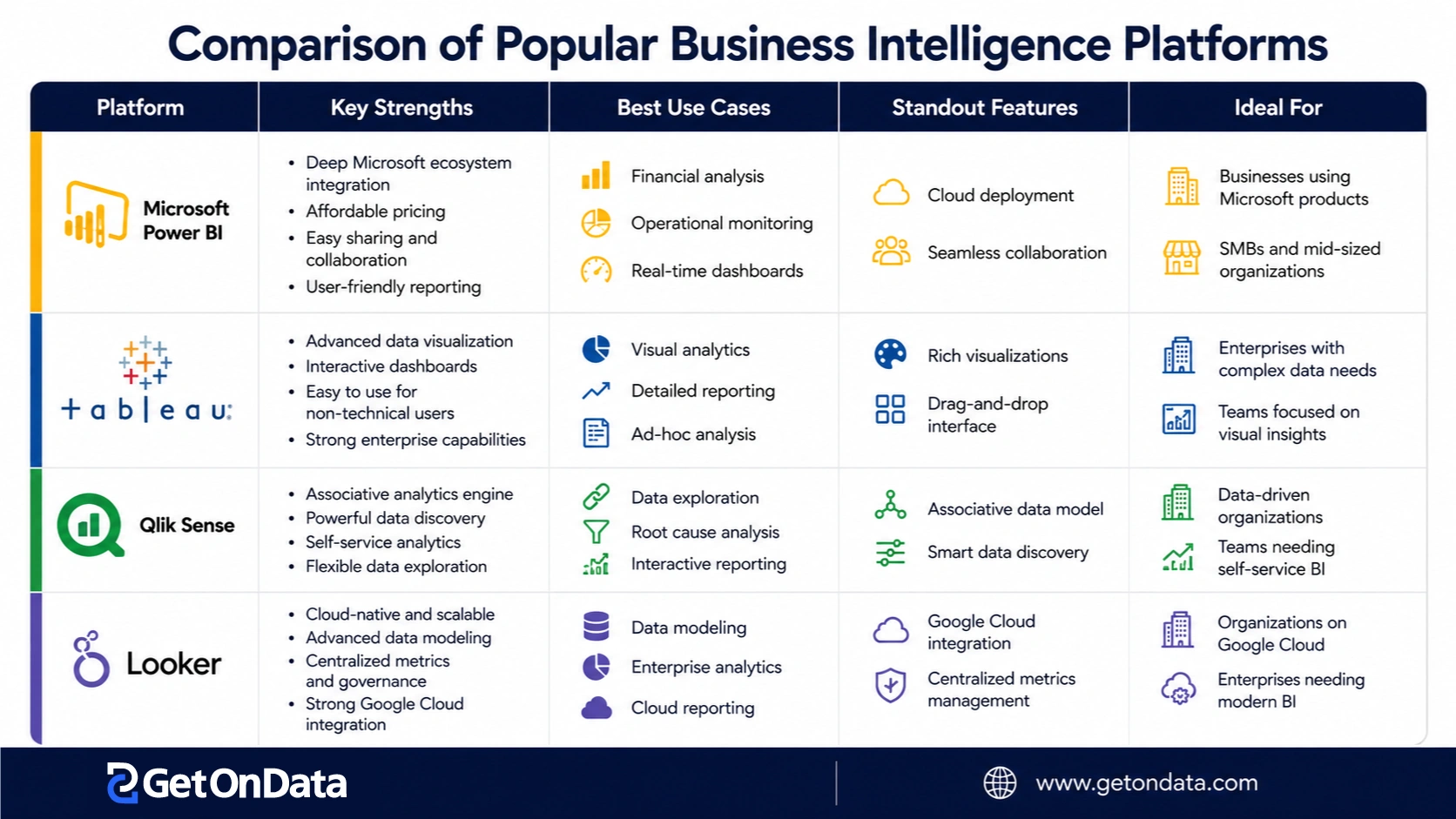
The BI market now comprises several market-leading vendors with some highly sophisticated BI tools for reporting, analytics, visualization, and data management. The best solution will depend on the size of your company, the volume of reports you need, your scalability objectives, and how you will incorporate it into your business. These are the key features that marketers focus on during the comparison process for the top business intelligence platforms, all of which are user-friendliness, AI features, pricing models, and cloud-based solutions.
1. Microsoft Power BI
One of the most widely used business intelligence tools for producing dynamic dashboards and reports is Microsoft Power BI. It seamlessly integrates with Microsoft products and is especially popular with organizations that already rely on Microsoft services.
➥ Strengths
• Enhanced Microsoft ecosystem integration
• Affordable pricing options
• The dashboard can be shared, collaboratively accessed, and edited with ease.
• User-friendly reporting tools
➥ Best Use Cases
• SMB reporting
• Financial analysis
• Operational monitoring
• Real-time dashboard reporting
➥ Pricing Considerations
Usability license, enterprise features, and cloud deployment requirements are determining factors in pricing. The ease with which an organization can use Power BI, along with its cost and functionality, is the reason for its classification as one of the best business intelligence solutions.
2. Tableau
Tableau’s strengths lie in its high-quality visualization and interactive dashboard features. Many companies rely on it because of its capability to provide detailed visual reporting and robust analytics capabilities.
➥ Visualization Advantages
For deeper insights, Tableau offers highly interactive dashboards, visualization tools for storytelling, and customizable charts.
➥ Enterprise Capabilities
It has enterprise-level analytics, large data volumes, and rich reporting needs.
➥ Ease of Use
Reports and dashboards can be created without a high level of coding skills, allowing non-technical teams to use them.
Tableau continues to be one of the top business intelligence platform solutions for data visualization and reporting flexibility for organizations.
3. Qlik Sense
The creation of associative analytics and flexible data exploration is the goal of Qlik Sense. It facilitates businesses to discover factors of correlation in their data sets and enhances decision-making.
➥ Associative Analytics Features
For users, facilitate a fast and efficient exploratory process about relationships among the data sources.
➥ Data Discovery Benefits
The platform provides interactive reporting capabilities, flexible filtering, and sophisticated data discovery tools.
For organizations needing scalable data BI solutions, they might consider Qlik Sense due to its powerful analytics and self-service reporting features.
4. Looker
Looker is a member of the Google Cloud product family and is cloud-first. It emphasizes data modeling, central analytics, and cloud commentators.
➥ Google Cloud Integration
Looker can be directly attached to Google Cloud technologies and Google Cloud data warehouses.
➥ Data Modeling Capabilities
The system offers highly sophisticated data modeling, enterprise analytics, and centralized metrics administration.
Considered by many as a modern business intelligence analytics solution, Looker is scalable, cloud-native, and offers cloud integration options.
Assess Integration with Existing Technology Stack
Integration is among the primary characteristics to consider in choosing a BI platform. A business intelligence solution must seamlessly integrate with the current systems, infrastructure, databases, cloud applications, and third-party applications you already have in place. Effective integration helps manage data better, eliminates manual tasks, and ensures seamless cross-departmental collaboration.
⇒ Compatibility With Current Business Systems
There are several types of platforms to choose from, and businesses should test their alternatives to see how well they integrate with existing technology. Organizations can use reliable BI data solutions to get data from several systems into one central solution.
➣ CRM Integration
The platform should be user-friendly and seamlessly align with customer relationship management systems to monitor sales analytics, customer interactions, and engagement metrics.
➣ ERP Connectivity
ERP integration improves financial analysis, inventory control, operational reporting, and business process tracking.
➣ Marketing Automation Tools
Marketing teams require integrated campaign reporting, consumer insights, and channel performance analytics.
Today’s Business Intelligence BI platform for analytics allows full integration of business departments to create better collaborations and reporting.
⇒ Data Warehouse and Cloud Compatibility
Scalable BI & data warehouse services are utilized by businesses that process extensive information to store and process it in a centralized manner. It should include support for the major cloud providers and the latest data warehouse technologies.
✧ Snowflake
Scalable data storage and analytics are the goals of this well-known cloud-based data warehouse technology.
✧ AWS
An enterprise-grade cloud infrastructure services provider offering robust analytics solutions and applications.
✧ Azure
Microsoft’s cloud offering provides enterprise-level analytics, reporting, and AI applications.
✧ Google Cloud
Enables scalable analytics, machine learning, and cloud-based solution reporting.
AI business intelligence platforms 2026 should feature robust cloud compatibility, scalability, and AI Features are important to prioritize.
➔ API and Customization Options
Each business has distinct operational and reporting needs. Modern custom enterprise business intelligence platforms should have flexibility, such as customization and API support.
⦾ Workflow Automation
Automation cuts down the manual reporting burden, increases efficiency, and accelerates data processing.
⦾ Custom Dashboard Development
Companies may have user-specific dashboards and reporting systems for various groups within their organization.
⦾ Third-Party App Integrations
The platform needs to be open to various API connections to other applications, analytics tools, and cloud services.
Also Read: Business Intelligence Implementation Roadmap for Business Leaders
Common Mistakes to Avoid When Choosing a BI Platform
1. Ignoring Scalability
A lot of organizations only choose the tools that they currently have. As business information grows, this frequently results in performance problems.
➞ Choosing Short-Term Solutions
Future restrictions may be caused by short-term planning. Scalable long-term analytics systems should always be the business’s investment.
➞ Underestimating Future Data Growth
Data volumes grow exponentially as businesses grow. The number of items in databases grows at a rapid rate as businesses grow. It can slow down reporting and efficiency of operations when it comes to poor scalability.
2. Overlooking User Adoption
You have to have a powerful platform or tool, but if the employees don’t use it, that platform or tool is of no value to you. User-friendly dashboards make your employees more engaged and productive.
➞ Complex Interfaces
Users are discouraged from using complicated dashboards. Adoption rates are enhanced with simple and interactive reporting tools.
➞ Lack of Training
Staff must be well-trained and oriented. Training programs enable teams to utilize business analytics tools better.
3. Focusing Only on Price
It’s possible that less expensive choices lack certain essential features! Businesses must take long-term value into account in addition to initial expenses.
➞ Missing Critical Features
Advanced analytics or integration might not be available on a free platform. Poor reporting functionality may lead to lower-quality reports and poor reporting scalability.
➞ Long-Term Operational Costs
The maintenance and upgrade costs may rise over time. I may have to pay extra fees that will impact ROI.
The best business intelligence platforms are not just low front-end, but also high front-end.
4. Neglecting Data Governance
These security threats are caused by weak governance. Data is being kept accurate and secure by good governance policies.
➞ Security Risks
Inadequate access control puts them at risk. Secure BI data solutions provide security for sensitive business data.
➞ Compliance Challenges
There could be financial and/or legal repercussions for noncompliance. Industry compliance/regulation should be adhered to carefully by organizations.
Good governance policies help propel reliable BI & data warehouse services.

Ready to Find the Right BI Platform for Your Business?
Deciding on a BI platform is one of the most crucial decisions of modern organizations. The preferred solution should be aligned to business objectives, scalable, efficient for reporting, and provide meaningful insights via advanced business intelligence analytics ability. By leveraging the appropriate analytics tools, businesses can benefit from better data-driven decision-making, greater operational efficiency, and a competitive edge in a data-driven marketplace.
The need for the most stellar business intelligence platforms for AI and the best business intelligence platforms for artificial intelligence are on the rise, particularly as companies continue to integrate AI-powered innovations into their operations. Today’s organizations have to adopt smarter reporting systems that enable automation, predictive analytics, and up-to-the-minute information. Choosing one of the best business intelligence platforms can be very beneficial for businesses that are dealing with a massive amount of data, as it can help them manage it more effectively and enhance their performance.
Some key considerations to explore while comparing the best bi & data warehouse services include user-friendliness, integration options, scalability, security, real-time analytics, and AI capabilities. There should also be reliable BI data solutions, and the advanced data BI solutions should assist in the smooth incorporation with cloud systems, enterprise ecosystems, and reporting instruments.
Growing businesses sometimes invest in a scalable BI & data warehouse service, and also opt for custom enterprise BI platforms that can withstand future business needs. With the right platform, companies can not only do better business reporting but also maximize the benefits of their data by implementing more effective business analytics strategies and making decisions based on data.

