
Modern businesses run on numbers, customer records, inventory stats, and operational metrics. When the information is confined in separate software tools, however, the decision-making process slows down. While project expenses are a key issue for modern leadership, seamless data pipelines are essential in connecting these systems. Data integration engineering services help businesses connect these systems efficiently. Businesses often ask: How much does connecting all our systems actually cost?
If there isn’t a clear financial road map, it is easy to let expenses go astray. According to Salesforce’s 2025 Connectivity Report, 95% of IT leaders struggle to integrate data across systems. This complete pricing guide will help you to understand precisely what it costs to combine your business information, so you can budget properly and prevent the unexpected price tag.
What Is Data Integration?
Data integration brings together information from various sources like cloud applications, databases, customer platforms to provide a single view for accurate reporting and decision-making.
It entails collecting raw data, cleaning and standardizing the data, and then uploading it to a central location, like a cloud data warehouse.
Data integration enhances reporting, helps bring customers into systems, and minimizes manual effort and mistakes. Data integration engineering services ensure data accuracy and dependable automated pipelines for businesses.
How Much Does Data Integration Cost in 2027?
The cost of data integration varies with the volume of data, its complexity and the size of the business. Their typical spending on basic SaaS connectors is 3,000–12,000 per year, while mid-sized companies would spend 15,000–60,000 per year on cloud tools and custom pipelines. High volume data processing, advanced security, custom architecture, and more can cost enterprise organizations 80,000 – 300,000+ per year.
Initial setup, pipeline design and configuration, historical data transfers, and software licenses, cloud storage, etc., create the total cost. Smaller companies have subscriptions to SaaS, mid-sized companies have a mix of subscription-based and usage-based tools, and larger enterprises have custom contracts and usage-based pricing.

Data Integration Cost Breakdown by Project Type
1. Cloud Data Integration Cost
Cloud pipelines can be used to pipeline applications directly in the cloud to cloud data warehouses. Typical monthly fees for platforms run from $200 to $2,500 and storage and computing costs are $100 to $1,500 per month depending on the size of the storage needed and how frequently queries are used.
2. API Data Integration Cost
Custom APIs are flexible enough to link applications together. The cost of creating custom API pipelines is usually $2,500 to $10,000 per endpoint, and third-party API usage fees range from $50 to $500 per month. Businesses need data integration consulting services to find the most critical API integrations for their business and manage their development costs.
3. ETL and ELT Integration Cost
ETL and ELT pipelines are used to move data to the enterprise reporting. The cost of building reliable transformation pipelines is typically 4,000 – 25,000, and processing costs vary based on data size and computing needs in the warehouse.
4. Real-Time Data Integration Cost
Real-time integration processes real-time events and requires a continuous data stream. The price of streaming infrastructure can range from 500 to 4,000 monthly, and automated monitoring is 300 to 1,200 monthly.
5. CRM and ERP Integration Cost
Platform integration (e.g. Salesforce, SAP, NetSuite) involves working with complex data structures. The cost of implementing two-way synchronization is normally $8,000 to $45,000 and the cost of custom enterprise connectors is $5,000 to $15,000 per connector.
6. Enterprise Data Integration Cost
Enterprise integration links various internal and external systems in different departments. Typical costs for large-scale projects range from 75,000 to 250,000 or higher and the security and scalability needs, such as private cloud, encryption, can add 10,000-40,000 per year.
Also Read: Top 7 Data Integration Companies in USA for Building AI-Ready Data
Key Factors That Affect Data Integration Costs
• Number of Data Sources: Three systems are easier to connect than 35 systems which are more complex to connect.
• Data Volume and Complexity: Complex schemas and large volumes of data drive up data processing and storage costs.
• Tools and Technologies: Commercial enterprise platforms will probably be more costly than open-sourced options.
• Batch vs. Real-Time Processing: Uses more computing resources than batch processing, but daily batch processing will be cheaper.
• Customization Requirements: Prebuilt connectors offer lower cost, custom integrations offer higher cost.
• Security and Compliance: Compliance with HIPAA, GDPR, and SOC 2 adds to configuration and security costs.
• Maintenance and Support: Ongoing monitoring and maintenance generally will come to 15-20 percent of project costs per year.
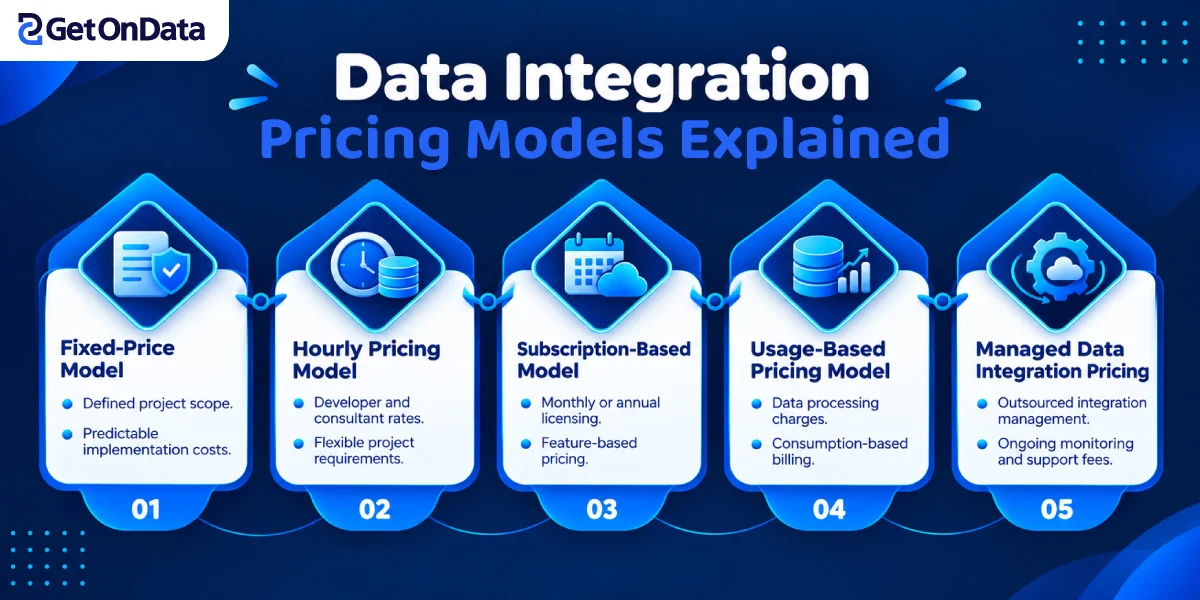
Data Integration Pricing Models Explained
1. Fixed-Price Model
Best suited for projects that have very specific requirements. The service provider provides service for a specific scope of implementation (e.g. $15,000) and allows for a predictable expenditure.
2. Hourly Pricing Model
Designed to support dynamic and flexible projects. The scope can be altered in an incremental fashion, and developers range from $50 to $200 per hour.
3. Subscription-Based Model
The cost of SaaS tools depends on a flat monthly or annual subscription fee with usage tiers for available features and connectors.
4. Usage-Based Pricing Model
Platform charges vary dynamically depending on the amount of data actually processed on the platform, whether by Monthly Active Rows (MAR), by gigabytes or by compute credits.
5. Managed Data Integration Pricing
Organizations can use pipeline services fully, for a monthly retainer fee (typically $1,500 to $8,000/month) which includes software, administration, and proactive fixes.
Data Integration Software Pricing Comparison
Cloud-based data integration tools can also be paid on a per-use basis, whereas on-premise solutions require investments in infrastructure, installation and maintenance. Open-source platforms can save on licensing costs while paid platforms offer enterprise and advanced features and support. When choosing big data integration services for your business, you should weigh factors such as subscription costs, data volume limits, processing fees, and maintenance costs.
| Pricing Factor | Cloud-Based Tools | On-Premise Tools |
|---|---|---|
| Initial Cost | Usually lower | Usually higher |
| Licensing | Subscription or usage-based | License or enterprise agreement |
| Infrastructure | Managed by the provider | Managed by the organization |
| Maintenance | Often included or shared | Primarily handled internally |
| Scalability | Flexible and usage-based | May require hardware upgrades |
◈ Popular Data Integration Tools to Compare
Examples of popular data integration tools are Informatica, Fivetran, Airbyte, Qlik Talend, Azure Data Factory, AWS Glue, and Boomi. The cost of their services depends on the amount of data, the type of connectors, deployment, and feature requirements. These are the factors to take into account when comparing them in order to choose the platform that suits the technical requirements and budget.
Step-by-Step Guide to Planning Your Data Integration Budget
◈ Step 1: Identify Your Data Integration Requirements
Establish goals for the operation and list all source databases, SaaS applications, and reporting targets.
◈ Step 2: Assess Data Volume and Complexity
Determine the total number of rows, total storage requirements, and any transformations that are needed.
◈ Step 3: Choose the Right Integration Approach
Determine the most suitable approach for your business’s SLAs – batch API calls, ETL pipelines, or real-time streaming.
◈ Step 4: Evaluate Integration Tools and Pricing
Make side-by-side comparisons of tool licenses, usage restrictions and cloud warehouse hosting charges.
◈ Step 5: Estimate Implementation Costs
Estimate how many hours it will take to implement internally or hire an outside consultant.
◈ Step 6: Calculate Ongoing Expenses
Consider software renewal costs, cloud storage costs and periodic pipeline maintenance.
◈ Step 7: Finalize Your Integration Budget
Calculate your Total Cost of Ownership (TCO) and allow a 15% contingency for any surprise increases in volume.
Also Read: A Step-by-Step Data Engineering Process for Successful Data Transformation
Hidden Costs of Data Integration Businesses Should Know
There are also a number of hidden pricing of data integration processes, in addition to software and implementation costs. Extra effort may be needed to correct duplicate or corrupted data in legacy systems for data cleaning and preparation. Changes to source APIs contribute to custom connector development costs, and API rate limits can lead to additional costs from SaaS providers.
Staff training is a cost since they need to become familiar with new analytics tools and dashboards. Pipeline retesting may be required for system upgrades and large historical data transfers can add up cloud storage and computing costs.
How to Calculate Your Total Data Integration Cost
The total price of data integration will vary depending on the software licenses, implementation fees, cloud computing costs, and any maintenance fees that are incurred. This way, businesses can project their financial commitment and budget accordingly.
◈ Total Cost of Ownership (TCO) Formula
Total Cost of Ownership (TCO) = Software Licenses + Implementation Fees + Cloud Compute + Maintenance Costs
Professional enterprise data integration services make it easier for companies to track the cost of the project from its deployment to its ongoing monitoring and maintenance.
◈ Sample Cost Calculation (Mid-Sized Enterprise)
For a mid-sized business, they may have to pay $12,000 annually for SaaS data pipeline licenses, $20,000 for the initial implementation, $4,800 annually for cloud warehouse computing and storage, and $3,600 annually for maintenance and engineering. These costs increase the cost of ownership after the first year to $40,400.
How to Reduce Data Integration Costs Without Compromising Quality
By choosing the tools that are right for their workloads and budget requirements, businesses can save on integration costs. Prebuilt connectors reduce development costs and automated testing finds errors in pipelines, thus reducing manual work.
Cloud computing can be cost effective in optimizing data storage by eliminating the need to store redundant historical data. By focusing on the most critical integrations first, businesses get to deploy applications that are of high value first and monitor recurring costs and alerts to keep unexpected bills at bay.
How to Choose the Right Data Integration Partner for Your Budget
Technical capabilities, platform experience, and pricing considerations are all crucial when selecting the right data integration partner. Companies should ensure that the provider will be able to use their data sources, cloud warehouses, and their preferred ETL platform, and compare fixed-price and hourly estimates.
Looking back at previous work and client examples of work completed will allow you to gauge the provider’s experience. Additionally, ensure that support is offered after the launch and ask for a comprehensive quote that contains a timeline, milestones, the support duties to be performed and any extra costs.
Ready to Make a Smarter Data Integration Investment?
Selecting the right partner is essential to maintaining project costs and performance. By working with an established data integration company, your team can leverage their proven tools, custom expertise in architecture and have a predictable timeline for implementation.
Estimate the current sources of your data, assess software pricing levels and speak with seasoned technical experts. By asking for a bespoke cost estimate you will have a financial blueprint for creating an efficient, fully-integrated enterprise data ecosystem.

