
Data transformation has become crucial for modern businesses that want to turn vast volumes of raw data into informative insights. Businesses must clean, organize, and integrate, prepare data before using it for reporting, analytics, and making decisions. This is where data engineering experts help. They build reliable systems that transfer data from various sources into organized formats.
Organizations often face challenges like poor data quality, disconnected systems, complex data sources, and rising data volumes. An organized data engineering process helps address these challenges by developing a clear path from raw data to actionable insights. It helps firms to improve data quality, consistency, and accessibility across the organization.
What Is the Data Engineering Process?
Data engineering is the approach of designing and managing systems that manage data efficiently. Data engineering experts develop pipelines to gather, process, store, and deliver data across an organization. The process involves data collection, storage, cleaning, transformation, integration, and quality testing. Data engineering consulting also tracks these systems to verify data remains secure, accurate, and available when required. An organized process allows firms to manage large and complex datasets while minimizing errors and improving data accessibility.
Why Data Engineering Is Important for Data Transformation
Data engineering is necessary for data transformation for the following reasons:
• It allows consistent access to data sources across departments. It helps teams avoid confusion from scattered spreadsheets.
• Data engineering can identify gaps and inconsistencies early, before they cause bigger errors.
• Businesses can make improved decisions with clean, well-organized data, and data engineering helps them.
• It supports multiple analytics and AI initiatives as data scales over time.
• Data engineering limits the reliance on manual data handling and delays.
Key Technologies Used in the Data Engineering Process
◈ Data Integration Tools
Data integration tools help to collect information from various sources, including databases, applications, and third-party platforms. They automate data extraction, transformation, and loading (ETL) into an organized system. Businesses can more easily integrate structured and unstructured data without human intervention by using tools like Talend and Apache NiFi. This gives teams a uniform perspective by removing data silos and ensuring consistency across systems.
◈ Cloud Data Platforms
AWS, Google Cloud, and Microsoft Azure are examples of cloud data systems that offer scalable infrastructure for handling and storing massive amounts of data. They provide flexibility to scale up or down based on business demands. Additionally, the platform supports real-time data access, team communication, and analytics tool integration. Cloud platforms are now the foundation of modern data engineering because of their integrated security and compliance capabilities. This enables companies to handle data effectively.
◈ Data Processing Frameworks
Large datasets may be processed in batch and real-time using frameworks like Apache Spark and Hadoop. For large-scale cleaning, transformation, and structuring of raw data, these technologies are crucial. To successfully deploy these frameworks and make sure pipelines are optimized for performance, many companies collaborate with a data engineering consultancy. The data volumes, complexity of processing activities, and speed requirements involved in a particular business use case determine the right framework.
◈ Analytics and BI Tools
Analytics and BI tools such as Power BI and Tableau transform data into visual insights once it has been processed and stored. Without requiring much technical knowledge, these tools allow teams to create dashboards, monitor KPIs, and recognize patterns. BI tools guarantee that decision-makers have rapid access to accurate data.
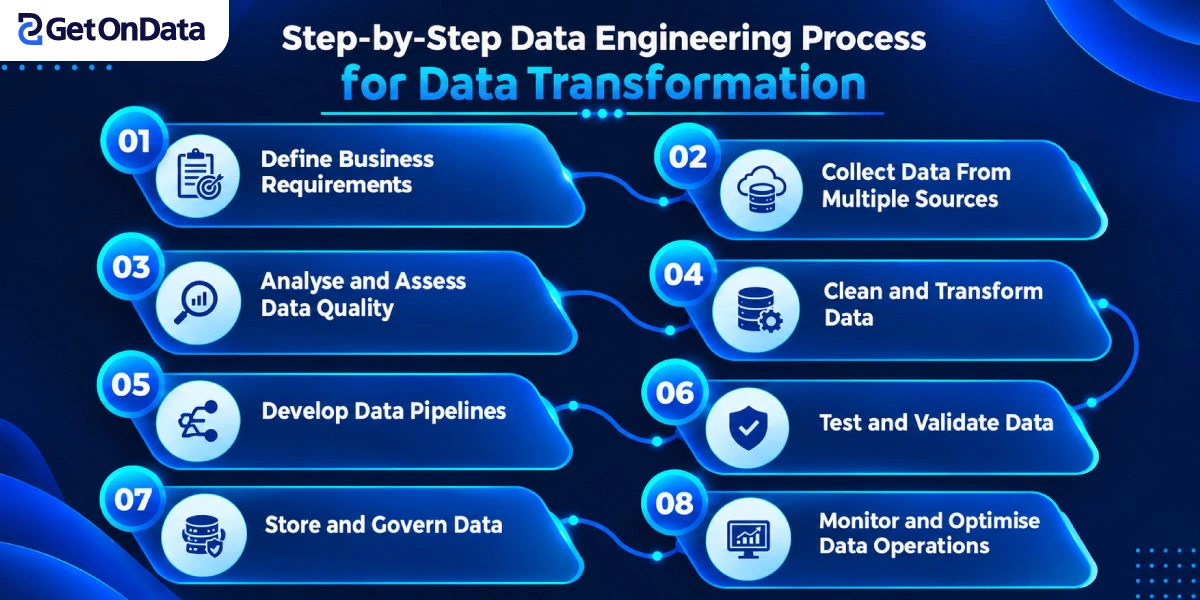
Step-by-Step Data Engineering Process for Data Transformation
The below data engineering process diagram defines key stages involved for transforming raw data into organized insights.
Step 1: Define Business Requirements
In the first step of data engineering process steps, figure out what the company expects to achieve. Establish measurable performance metrics, decide what data is required, and identify important business objectives. Data teams can choose the best data sources, transformation techniques, and technologies with the help of well-defined requirements. Additionally, they make sure that, rather than adding unnecessary complexity, the final data solution supports real business needs.
Step 2: Collect Data From Multiple Sources
Spreadsheets, cloud platforms, databases, apps, APIs, and other systems provide data. Establish reliable data ingestion procedures and find suitable sources based on the specified requirements. Organize raw data appropriately after gathering it from multiple sources.
Step 3: Analyse and Assess Data Quality
Evaluate the quality and structure of the data before transforming it. Missing values, duplicates, inconsistencies, incorrect formats, and other issues can be found with the help of data profiling. Additionally, teams should verify that the data is correct, comprehensive, and relevant to business needs. Early detection of these issues reduces errors during the next phase and improves the final datasets’ consistency.
Step 4: Clean and Transform Data
To make the gathered data consistent and suitable for business use, clean and transform it. This step is necessary to avoid mistakes, duplicates, and unnecessary records. After that, data engineering experts use business rules to produce useful datasets. These procedures guarantee that transformed data can be used efficiently for analytics and reporting.
Also Read: Best Data Engineering Tools for Building Scalable Data Pipelines
Step 5: Develop Data Pipelines
Data pipelines automate the transfer and processing of data between several systems. Based on the data flow diagram process, data engineering consultants create appropriate ETL or ELT procedures. Automation offers routine data processing and decreases manual labor. Error-management techniques should be integrated into pipelines to identify errors and maintain consistent data flows.
Step 6: Test and Validate Data
Testing guarantees that transformed data satisfies business needs and expected quality. Teams compare outputs with predetermined criteria, verify transformation results, and assess data accuracy. Information that is inconsistent or missing can be found through data quality checks. Before datasets are live for analytics, reporting, or other business applications, thorough validation guarantees their quality.
Step 7: Store and Govern Data
It is necessary to store transformed data on suitable platforms, like cloud storage systems and data warehouses. Additionally, organizations should put security controls in place to control access and secure sensitive data. Clear guidelines for data ownership, quality, privacy, and usage are established by data governance. When combined, these procedures help in maintaining the security, organization, and reliability of company data.
Step 8: Monitor and Optimise Data Operations
Following the deployment of pipelines and systems, data engineering requires ongoing monitoring. The team monitors pipeline performance, processing times, errors, and problems with data quality. Frequent optimization can support increasing data volumes, lower resource consumption, and increase processing efficiency. Additionally, ongoing maintenance keeps data systems secure and helps in the early detection of technical issues.
Common Challenges in Data Transformation
▸ Poor-quality or incomplete source data – Poor quality data contains missing, duplicate, and incorrect data, making data transformation and analysis less reliable. It increases the risk of inaccurate business decisions. Based on a report by IBM’s 2025, 43% of chief operation officers identified poor data quality, highlighting the importance of managing accurate data throughout the transformation process.
▸ Data integration difficulties – Integrating data from various sources can be tough since formats and structures may vary, causing inconsistencies across integrated datasets. Taking help from enterprise data engineering consulting helps organizations address them.
▸ Changing schemas – Changing schemas and source data can hamper pipelines and require regular updates to data workflows and integration processes.
▸ Large data volumes – Processing large datasets can increase storage requirements. It makes efficient data processing and resource management necessary.
▸ Pipeline failures – Pipeline failures can hamper data improvement and delay access to updated information, affecting reporting, applications, and business operations.
▸ Security and compliance concerns – Since data transformation creates security and compliance risks if access controls, encryption, and regulatory requirements are not managed properly.
▸ Performance and scalability issues – Poorly designed data systems may experience slow processing and performance errors as data volumes and business requirements scale.
Best Practices for Successful Data Transformation
⇒ Create a Clear Data Strategy
Building a clear data strategy guarantees that transformation efforts support business goals. Organizations should describe how they collect, manage, store, and use data over time. A long-term plan helps teams establish priorities, allocate resources, and develop a consistent approach to managing data across departments.
⇒ Prioritise Data Quality
High-quality data is important for reliable analytics and business decisions. Firms should manage accurate, consistent, and complete datasets throughout the data lifecycle. Frequently checking data quality helps identify errors, missing values, and inconsistencies early. Monitoring data quality ensures that problems are identified early.
⇒ Automate Data Workflows
Automating data workflows reduces repetitive manual workflows and makes data processing efficient. Automated pipelines can gather, transform, and transfer data consistently across systems with less human intervention. It allows teams to focus on high-value tasks, improves processing speed, and reduces the risk of manual errors.
⇒ Focus on Security and Compliance
Data transformation must include strong security and compliance practices from the start. Organizations must protect sensitive business data through encryption, access controls, and secure data practices. The data engineering consulting services follow relevant industry regulations and safety compliance. This reduces security errors while managing customer trust and data.
⇒ Build Scalable Data Infrastructure
Data infrastructure should be designed to manage rising data volumes and changing business needs. A scalable system allows firms to expand data operations without any costly redesign. It supports advanced analytics, ML, and AI workloads. It develops a flexible foundation for future growth.
Also Read: Data Engineering Company in USA for Secure & Scalable Data Infrastructure
How Data Engineering Enables Successful Data Transformation
➥ Creates a reliable foundation for business intelligence
Data engineering develops reliable data pipelines and structured datasets. It gives the BI team accurate and consistent data for reporting and analysis.
➥ Helps organisations unlock value from raw data
Data engineering changes raw and unstructured data into usable datasets, allowing organizations to uncover meaningful metrics and support valuable business outcomes.
➥ Supports AI and machine learning initiatives
Well-designed data provides AI and ML systems with reliable, accessible, and well-maintained structured information required for effective model development and performance.
➥ Improves operational efficiency
Automated data pipelines reduce manual process errors and streamline data workflows. Data engineering allows firms to improve productivity and use resources efficiently.
➥ Enables faster and smarter decision-making
Accessible data helps decision-makers by offering accurate, on-time insights so that they can respond quickly to business decisions.

Looking for the Right Data Engineering Strategy for Success?
Successful data transformation needs an organized approach that turns raw data into reliable business values. The process starts with a better understanding of business needs and continues through data collection, transfer, testing, and ongoing monitoring. A skilled data engineering consulting company allows firms to design and manage this process effectively.
The experts prioritize data quality, scalability, automation, security, and governance should remain priorities through workflow. With the right strategy and infrastructure, firms can improve data reliability, support analytics, and make faster decisions. A well-designed data engineering strategy helps organizations to change complex data into actionable metrics.

