
Running a modern business in 2027 involves managing multiple digital tools, including cloud platforms, AI agents, CRM, and ERP systems. When these apps don’t talk to each other, though, businesses are stuck with data silos, delayed reporting and inefficient operations. This is where enterprise data services come in handy, allowing them to connect various systems and enhance data transfer between departments.
Without integrations, teams spend time manually transferring information and making decisions based on outdated data. According to MuleSoft, 90% of organizations face business challenges due to data silos. This guide delves into the top 10 enterprise data integration challenges in 2027, along with solutions to address them.
What Is Enterprise Data Integration?
Data integration for enterprises is the process of merging data from several software applications, databases, and cloud services into a dependable, consolidated perspective. Integration brings sales, finance, and operations from different silos of information together, allowing data to move seamlessly among these tools.
It’s essential to have a single source of data for day-to-day business. As systems push each other with accurate insights and updates, leaders can rely on accurate insights, automate repetitive tasks, and fuel modern tools of AI with clean facts. Reliable enterprise data integration services guarantee that all analytics dashboards and AI-driven decision making are supported by thorough and current enterprise data.
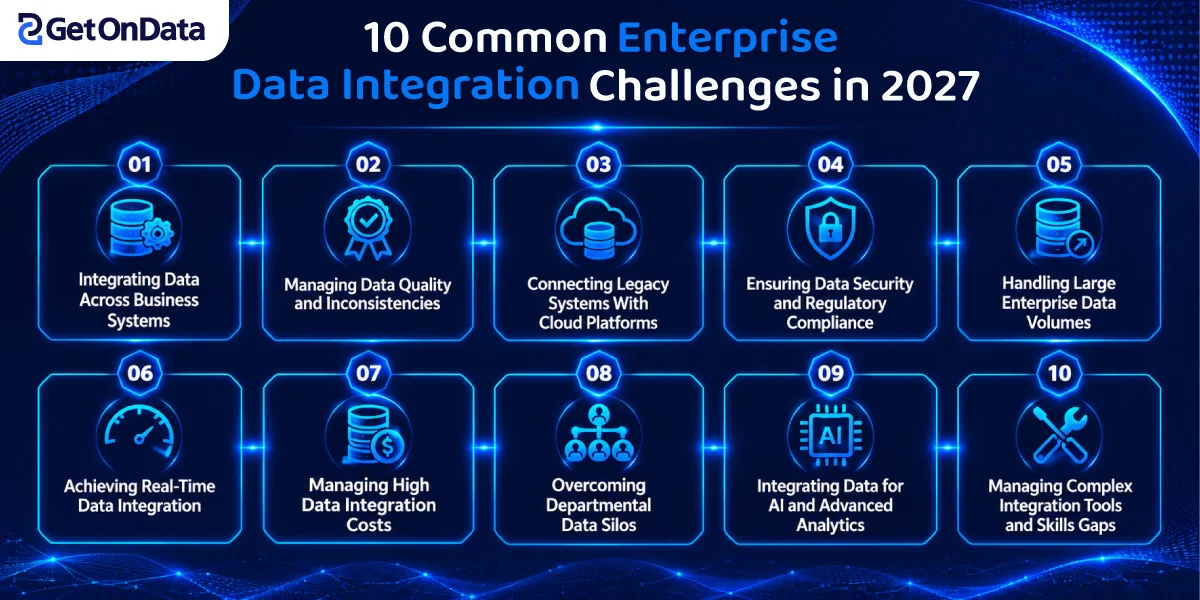
10 Common Enterprise Data Integration Challenges in 2027
It’s difficult to integrate a company’s entire technology stack, even in today’s day and age of technology. Ten of the largest data integration challenges enterprise face today:
1. Integrating Data Across Multiple Business Systems
A typical large or medium-sized company would have separate platforms handling CRM, ERP, Human Resources (HRMS) and Customer Support. Different kinds of data formats and rules are used for each tool. Ensuring these platforms share the information without corruption or dead links is a significant enterprise data integration problem and for some often needs custom connectors.
2. Managing Poor Data Quality and Inconsistencies
Duplicate data, missing fields and stale customer information add up when your company receives information from 10 different sources. Bad records result in bad financial reports and make for bad decisions by leaders. In each connected app, strict validation rules are necessary to maintain a high level of accuracy.
3. Connecting Legacy Systems With Modern Cloud Platforms
Even some of the well-known companies continue to operate on legacy on-premise software that wasn’t designed for the cloud. Integrating these old tools with today’s cloud-based applications is fraught with compatibility problems. The owners of the old systems can modernize these systems without interrupting daily operations by working with data integration consulting services.
4. Maintaining Data Security and Regulatory Compliance
The transfer of sensitive customer and financial information between platforms can raise the threat of leaks or unauthorized access. To meet stringent industry regulations and international privacy laws in 2027, business owners must put in place robust encryption, access control, and data privacy protocols.
5. Handling Large Volumes of Enterprise Data
Information is created on a massive scale at businesses every day, through websites, mobile applications, sensors, transactions, and more. In older setups, they tend to crash or slow down when overloaded. Many organizations rely on large data integration services to create scalable pipelines that can process large volumes of data without compromising performance.
Also Read : Data Integration Cost in 2027: Complete Pricing Guide for Businesses
6. Achieving Real-Time Data Integration
Customer expectations for instant response times and AI tools’ demand for real-time data dictates that overnight batch updates are no longer sufficient. While using delayed records results in stockouts, slow customer support, and lost sales opportunities, creating a real-time streaming pipeline is technically challenging.
7. Managing High Data Integration Costs
For many companies, software licensing, cloud compute costs, and custom connector maintenance can quickly consume IT budgets. When a software vendor changes its API, and it disrupts an existing link, it is often when hidden costs come into play. Owners need to consider their investment in integration versus business return of investment (ROI).
8. Overcoming Data Silos Across Departments
Without the ability to share data across departments, it becomes difficult to collaborate among marketing, sales, finance, and operations teams. Having no single source of truth leads to division between teams on whose numbers are correct, and an almost impossible way to paint an overall picture of company performance.
9. Integrating Data for AI and Advanced Analytics
AI models and machine learning tools go awry when given messy or incomplete records. Almost 90% of all the data in modern business is unstructured, like emails, PDFs and call logs. Combining unstructured files with structured database tables is a tough enterprise data integration challenge that blocks successful AI adoption.
10. Managing Complex Data Integration Tools and Skills Gaps
While there are great features to be found on modern integration platforms, configuration is not simple and does not come with a lot of experience. There are not enough skilled engineers to maintain pipelines and solve problems with broken workflows and complex architectures in many companies.
How Can Businesses Overcome Enterprise Data Integration Challenges?
Enterprise data integration problems call for a planned approach instead of simple, short-term solutions. Five practical steps to establish a solid data foundation for the business are:
◇ Develop a Clear Data Integration Strategy
First, identify your core business objectives such as faster financial reporting, or improved customer tracking. Draw a picture of where your important data resides, how it interdepends, and how it’s likely to benefit you the most right now.
◇ Choose Scalable Data Integration Solutions
Move away from out-of-the-box, custom-coded links and to cloud-based solutions. Using modern enterprise data integration services gives your tools access to automated workflows, easy scalability, and seamless compatibility with new business apps.
◇ Implement Strong Data Governance Practices
Establish clear company-wide guidelines on how data is formatted, stored and protected. Designate data owners for each dataset and have very strict access policies to ensure that sensitive data are only read by team members and AI tools.
◇ Automate Data Integration Workflows
Reduce manual uploads of spreadsheets and repetitive copying/pasting. Records are synced automatically between your apps at regular intervals or as soon as they change, reducing human error and freeing up your staff’s time for high-value tasks.
◇ Work With Experienced Data Integration Specialists
When your internal IT department is not available or hasn’t the bandwidth or the expertise, hire outside resources. By working with data integration engineering services or data integration consulting services, you will be able to create resilient architectures, join complex big data integration services, and prevent costly mistakes.
What Should Business Owners Consider Before Investing in Data Integration?
When choosing software or a data integration company, consider all options based on these six factors:
• System Compatibility: Can the solution be easily integrated into existing CRM, ERP, and legacy systems?
• Security and Compliance: Does it provide robust protection, audit trails, and adherence to privacy laws and regulations?
• Total Cost of Ownership: What are the upfront setup fees, ongoing subscription costs, and maintenance expenses?
• Future Scalability: Will the setup scale up to accommodate 5 or 10 times the amount of data when your company grows?
• AI and Real-Time Readiness: Can it support real-time data streaming and clean formatting for AI tools?
• Expected ROI: How many hours of manual work will it save, and how fast will it pay for itself?
Also Read : Top 7 Data Integration Companies in USA for Building AI-Ready Data
Key Business Benefits of Solving Enterprise Data Integration Challenges
When an enterprise-wide data integration problem is resolved, your company’s day-to-day operations change:
• True Business Reporting: Leaders receive reliable, consistent data from all departments.
• Quick Decision Making: Live metrics provide instant visibility of trends and allow managers to take action before problems arise.
• Reduced Manual Data Entry: Automation saves time on manual data entry and software duplication.
• Improved Team Alignment: Sales, finance, and operations work effectively together with a single source of truth.
• True AI Readiness: Clean, well-organized pipelines power accurate predictive analytics and AI agents.
• Better Business Agility: It takes much less time to add new tools, launch new products or enter new markets.
Ready to Simplify Enterprise Data Integration in 2027?
Enterprise data integration is not just an IT issue, but a business need that helps to boost efficiency, security, and growth. If all your software platforms share clean, accurate records in real-time, your teams will be faster and smarter to make decisions.
This quarter makes an effort to review existing systems and determine where data is being siloed and negatively affecting your staff. From Data integration engineering services to strategic data integration consulting services, scalable big data integration services to continuous enterprise data integration services, an experienced enterprise data consulting will keep your systems connected and ready for the future. Contact a reputable data integration provider now to create a seamless data infrastructure for 2027 and beyond.

