
Many companies gather a lot of data daily, but only a few understand how to transform information into decisions that matter. Often, data gets scattered across various systems without a proper framework, so uncovering significant insights becomes impossible.
That is why a data analytics maturity model is so crucial. Apart from organizing and analyzing data, businesses that choose to collaborate with data analytics service providers will be able to use their data to enhance their performance, customer experiences, and business growth opportunities.
Because competition is becoming fierce in all markets, firms are relying on analytics increasingly to be able to make decisions faster and wiser. But the transition from just being able to report data to utilizing advanced analytics necessitates a detailed plan for moving forward. A robust maturity model not only presents a clear picture of the present level of analytics exposure but also highlights avenues for future enhancements. According to McKinsey, data-driven organisations are 23 times more likely to acquire customers and 19 times more likely to be profitable, demonstrating the growing impact of analytics on business performance.
In today’s society, making decisions based on data is becoming essential. Companies are leveraging data to get insights into customer behavior, improve their operational performance, cut costs, and find new avenues for growth. Nevertheless, many run into issues arising from unorganized data, disconnected systems, and inconsistent reporting processes.
Having a maturity model in place that breaks down analytics aspects can guide businesses to assess their existing analytical capabilities and decide on their next steps. With the help of expert data analytics services, companies can not only lay a stronger analytics foundation but also achieve better outcomes.
Understanding Analytics Maturity
◈ Definition of Data Analytics Maturity
A data analytics maturity model is a tool to assess a business’s ability to use data effectively in decision-making. It looks into aspects like data gathering, handling, reporting, governance, and advanced analytics functionalities.
Businesses can determine their level of analytics deployment and opportunities for improvement by using the analytics maturity model. When a strong data and analytics maturity model is implemented properly, it opens up immense possibilities for businesses to convert raw data into meaningful business intelligence.
◈ Why Analytics Maturity Matters
Analytics maturity is an indispensable element of organizational success since it:
• Improves operational efficiency
• Enhances business decision-making
• Increases productivity
• Reduces risks
• Supports long-term growth
Besides these, companies that have a business analytics maturity model in place will use their analytics capabilities to gain a competitive advantage through better insights and faster decision-making. Likewise, a digital analytics maturity model is very effective and aids businesses in optimizing their digital channels and customer experiences.
◈ Core Components of Analytics Maturity
The degree of analytics maturity is influenced by several factors:
• The right way of collecting and managing data.
• Data visualization and reporting.
• Predictive analytics
• Artificial intelligence
• Automation technologies
Custom data analytics may be applied to solve specific business needs and contribute to business goals for long-term analytics. These custom data analytics solutions enable companies to handle massive data volumes while delivering accurate data reporting. Businesses evolve over time, and with that comes the need for advanced data analytics solutions like custom forecasting, automation, and strategic data planning.
Understanding the Different Stages of Analytics Maturity
⇒ Stage 1 – Basic Data Collection
Key Characteristics
• Data stored in spreadsheets
• Separate and disconnected systems
• Manual reporting processes
Common Challenges
• Duplicate records
• Inconsistent data
• Limited business visibility
Improvement Tips
• Centralize business data
• Implement basic reporting tools
• Standardize data collection practices
⇒ Stage 2 – Standardized Reporting and BI
Key Characteristics
• Dashboard implementation
• KPI monitoring
• Business intelligence reporting
Common Challenges
• Departmental data silos
• Heavy IT dependence
Improvement Tips
• Integrate multiple data sources
• Create governance standards
• Improve reporting consistency
⇒ Stage 3 – Managed Data Integration
Key Characteristics
• Connected CRM and ERP systems
• Data consistency increased
• Collaboration across teams improved
Common Challenges
• Complex integrations
• Communication gaps
Improvement Tips
• Employ cloud integration platforms
• Partner with big data analytics service providers for scalable infrastructure
Directing the services of skilled big data analytics service providers to progressively connect the disparate systems and enhance analytics capabilities is what most organizations do.
⇒ Stage 4 – Advanced Analytics Adoption
Key Characteristics
• Use of predictive analytics models
• Forecasting ability
• Planning backed by data
Common Challenges
• Lack of analytics skills
• Difficulty in scaling
Improvement Tips
• Provide employee training
• Automate recurring report creation
• Enhance analytics capabilities
Most businesses try to use big data analytics services at this level as they help them to handle large datasets and improve forecasting.
⇒ Stage 5 – AI-Powered Analytics
Key Characteristics
• Machine learning applications
• AI-driven recommendations
• Intelligent automation
Common Challenges
• High costs of implementation
• Data quality issues
Improvement Tips
• Employ enterprise AI platforms
• Strengthen data quality practices
• Evaluate AI performance regularly
To gain deeper insights and automate more complicated decisions, the majority of enterprises use artificial intelligence with big data analytics services.
⇒ Stage 6 – Real-Time Analytics Enterprise
Key Characteristics
• Live dashboards
• Real-time monitoring
• Faster decision-making
Common Challenges
• Handling large data streams
• Ensuring system reliability
Improvement Tips
• Invest in cloud analytics infrastructure
• Continuously monitor analytics performance
Companies that have implemented advanced business analytics platforms are not only getting immediate insights into operations and customer activities but also achieving a faster response time aligned with their business goals.
⇒ Stage 7 – Data-Driven Enterprise
Key Characteristics
• Strong data culture
• Analytics integrated across departments
• Continuous innovation
Common Challenges
• Keeping innovation alive
• Managing enterprise-wide governance
Improvement Tips
• Promote lifelong education
• Work closely with big data analytics service providers for scalability and optimization in the long run
Top-performing companies usually engage the services of big data analytics service providers to sustain competitiveness and continuously enhance their analytics capabilities.
Also Read: Best Healthcare Data Analytics Tools for Hospitals, Clinics, and Healthcare Enterprises
How to Assess Your Organization’s Analytics Maturity
✦ Evaluate Current Data Infrastructure
Look at:
• Data storage solutions
• Current analytics tools
• Integration mechanisms
• Reporting systems
Many companies collaborate with data analytics service providers for infrastructure assessment and modernization planning.
✦ Analyze Team Skills and Data Culture
Check:
• Level of analytics knowledge among employees
• Extent of leadership involvement
• Data-driven decision-making approaches
• Interdepartmental cooperation
People and culture are two major components that determine the success of a business analytics maturity model.
✦ Measure Data Governance Practices
Evaluate:
• Data protection strategies
• Adherence to compliance requirements
• Data validity measures
• Risk mitigation techniques
Effective governance is the backbone of any data and analytics maturity model.
✦ Identify Business Goals and KPIs
Track:
• Revenue increase targets
• Customer experience standards
• Operational efficiency measures
• Business performance goals
Businesses will be able to move through the analytics maturity model more successfully if they have clear objectives.
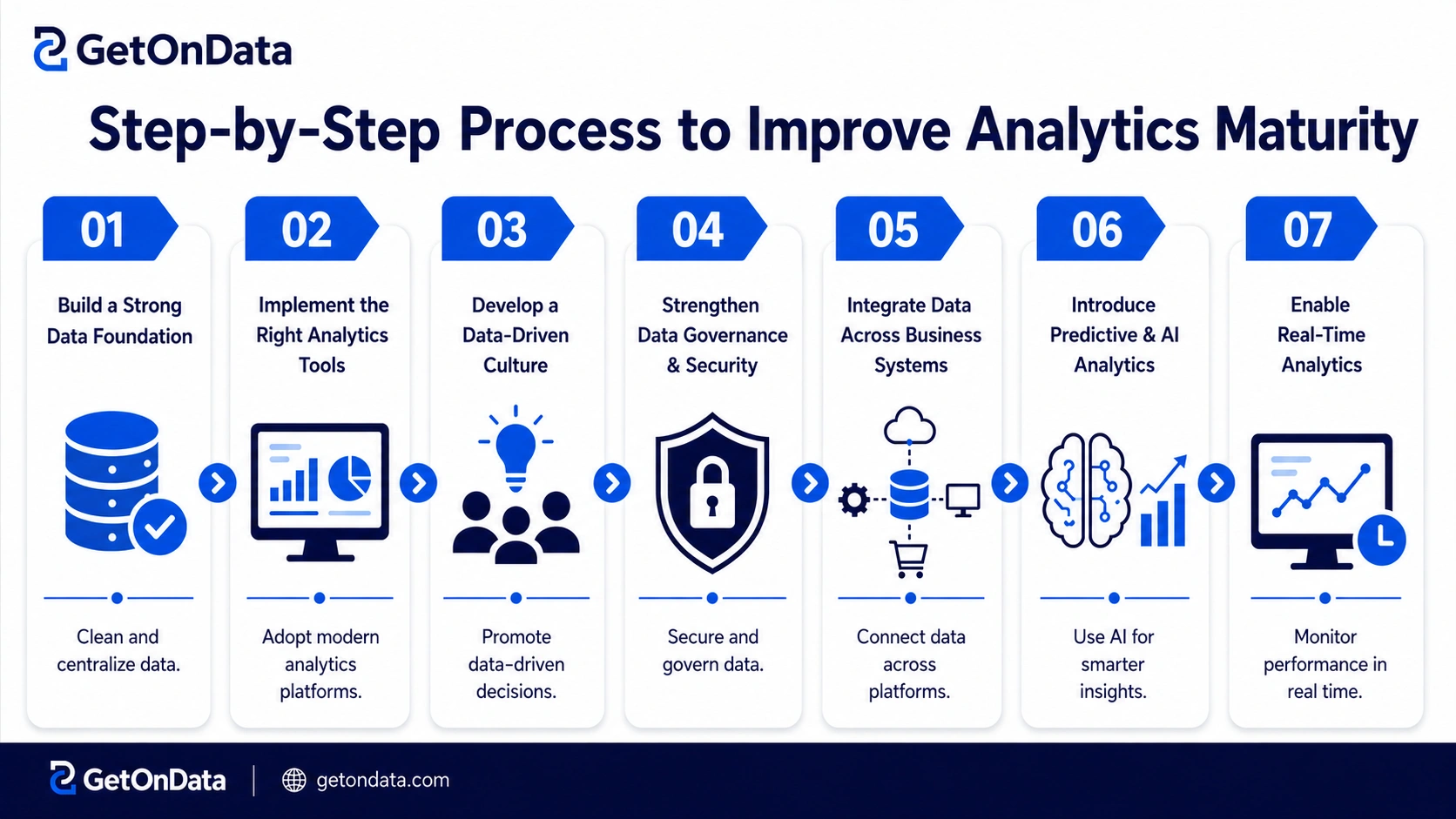
Step-by-Step Process to Improve Analytics Maturity
➔ Step 1 – Build a Strong Data Foundation
Businesses should:
• Sort out existing data
• Eliminate duplicates
• Enhance data quality
• Set up centralized databases
Enterprise data analytics services can be of great help to organizations in implementing strong governance, gaining efficient accessibility, and maintaining high-quality data standards. Such services that focus on enterprise data analytics also allow for the scalability of operations in the long run.
➔ Step 2 – Implement the Right Analytics Tools
Organizations can:
• Introduce reporting tools
• Implement cloud analytics solutions
• Automate the creation of dashboards
• Increase data availability
Use of modern business analytics platforms allows members of the teams to come up with quicker and more well-informed decisions.
➔ Step 3 – Develop a Data-Driven Culture
Concentrate On:
• Employee skill development
• Programs to increase data literacy
• Interactions between teams
• Decision-making based on evidence
A powerful culture will speed up performance gains in any data analytics maturity model.
➔ Step 4 – Strengthen Data Governance and Security
Enterprises must:
• Develop governance rules
• Secure sensitive data
• Comply with regulations
• Regularly check data quality
One of the key components of any effective digital analytics maturity model is governance.
➔ Step 5 – Integrate Data Across Business Systems
Big companies can:
• Link their CRM systems
• Integrate their ERP systems
• Remove data silos
• Develop unified platforms
Several data analytics service providers specialize in eliminating data silos and creating seamless integrations across multiple platforms.
➔ Step 6 – Introduce Predictive and AI Analytics
Companies may:
• Create forecasting models
• Apply machine learning techniques
• Automate decision-making
• Customize customer experiences
Advanced big data analytics services primarily support not only the implementation of predictive analytics but also the accurate forecasting of the business through these initiatives.
➔ Step 7 – Enable Real-Time Analytics
Companies must:
• Constantly monitor KPIs
• Track live business performance
• Work on improving response times
• Increase operational flexibility
Enterprise data analytics services have been the choice of many companies to set up trustworthy real-time reporting environments. Such data analytics services assist organizations in handling increasing data volumes while at the same time maintaining performance levels.
Common Challenges Businesses Face in Analytics Maturity
✧ Poor Data Quality
Data-related problems:
• Duplicate records
• Missing information
• Inconsistent standards
When data quality is poor, progress in a data and analytics maturity model is impeded.
✧ Resistance to Change
Other problems include:
• Employee resistance and fear
• Leaders not aligned
• Using analytics tools is not widespread
Besides data analytics service providers, enterprises have also been seeking extrinsic support in terms of change management and user adoption.
✧ Limited Budget and Resources
Constraints include:
• IT costs
• Shortage of skilled people
• Training
By investing strategically in custom data analytics solutions, businesses can maximize value while controlling costs. In fact, many organizations use custom data analytics solutions to improve efficiency without replacing entire systems.
Security and Compliance Concerns
Considerations have to be given to:
• Data privacy laws
• Cybersecurity vulnerabilities
• Meeting compliance requirements
Governance practices that are strengthened at a strong level support every stage of a business analytics maturity model.
Also Read: Top 10 Data Analytics Companies in India (2026 Edition)
Best Practices for Building a Successful Analytics Strategy
➡ Align Analytics with Business Goals
Pay attention to:
• Outcomes that can be measured
• What business is focusing on
• Getting better
An analytics model that matures helps a business achieve its strategic objectives.
➡ Invest in Scalable Technologies
It is advisable that enterprises:
• Use cloud-based technologies
• Tools that harness AI
• Modern business analytics platforms
• Infrastructure that is flexible
Technologies that can scale will be able to support the growth of the organization even in the future.
➡ Focus on Data Governance
Areas most critical include:
• Security management
• Compliance monitoring
• Data quality controls
• Risk reduction
Governance has always been and remains critical to every digital analytics maturity model and data analytics maturity model.
➡ Encourage Continuous Learning
Encourage:
• Training on analytics
• Certification programs
• Knowledge-sharing sessions
• Runs of Innovation
Ongoing training is one of the best ways to ensure that your team continues getting the most out of big data analytics services, business analytics platforms, and other advanced tools.

Transform Your Business with Smarter Analytics Strategies
No two organizations’ analytics journeys are exactly alike, but an understanding of one’s current maturity level is the key to success. From a business that is collecting data in spreadsheets to another that is using leading-edge AI-powered systems, everyone can benefit from a structured data analytics maturity model that offers a clear pathway for improvement.
Take stock of what your current capabilities are, find out where there are gaps, and devise a plan that will lead you to growth. Additionally, by using the latest business analytics platforms, investing in enterprise data analytics services, adopting custom data analytics solutions, and cooperating with skilled data analytics service providers and big data analytics service providers, businesses are able to uncover the full potential hidden in their data.
The organizations that consistently uplift their analytics maturity model, reinforce their business analytics maturity model, and evolve their data and analytics maturity model will be in an excellent space to make intelligent decisions, raise customer satisfaction levels, and enjoy greater long-lasting business success.

