
Along with websites, applications are one source by which modern businesses create data. Other sources include customers’ interactions, various transactions, devices, etc. As a larger volume of data is accumulated, data engineers often get stuck manually doing the same data management tasks time and again, such as moving data, updating pipelines, testing, monitoring, handling errors, etc. This results in slower reporting, and it is harder to support new business needs.
Data engineering consulting services could enable businesses to find these problems and create a better solution. One of the options is to implement data engineering automation. This technique combines tools and standardized procedures in order to minimize manual interventions and streamline workflow in different parts of the data lifecycle.
Data operations can be significantly faster, more efficient, and easily scalable with the help of automation. Besides, it can be a great tool for shifting the focus of a team from routine work to creative work. A Wakefield Research study found that 46% of data teams achieve 30–50% productivity gains using Generative AI. This article outlines how businesses can gradually integrate data engineering automation, identify suitable technologies, optimize data quality, and build a state for AI-ready data.
What Is Data Engineering Automation?
Systems that can automate data engineering tasks with little human intervention. Automated workflows do those tasks based on rules or triggers, rather than having to be repeated by engineers.
Examples of common activities that can be automated include data extraction, data transformation, data loading, scheduling data pipelines, testing and validating data, monitoring, alerting, deployment, and recovery. Another aspect of data flow that can be automated is the dependency between various data flows.
Automated data engineering can enable consistent, repeatable workflows. Organizations can handle larger amounts of data and more complicated processing demands at a higher rate without additional manual effort with big data engineering automation.
Additionally, AI can be integrated into data engineering automation to detect patterns, forecast pipeline issues, suggest enhancements, or help with repetitive tasks, all as part of a robust automation strategy. In a similar way, AI automation in data engineering can aid in monitoring, data quality verification, and workflow management.
Why Should Businesses Automate Data Engineering?
Reducing manual work is not the primary objective of automation. It assists engineering teams to operate faster, more accurately, and efficiently with increasing data volumes.
Tasks like data movement, testing, validating, deployment, monitoring, etc. can be automated to add value to businesses. This minimizes mistakes, accelerates data transfer, and enables teams to manage more data without extra manual work.
Data engineering experts can help businesses focus on data architecture, optimization, analytics, and AI projects, while eliminating repetitive tasks and boosting overall productivity. Good and timely data also provides a more solid base for advanced analytics and machine learning.
Data engineering consulting can help businesses determine the best opportunities for automation and develop a realistic implementation plan. This can help streamline high-value processes without the risk of data operations being disrupted or unreliable.
A Step-by-Step Guide to Implementing Data Engineering Automation
• Step 1 – Assess Your Existing Data Engineering Environment
First of all, conduct a thorough review of the existing data environment. The elements to be reviewed can be data sources, databases, cloud platforms, data storage, pipelines, data transformation methods, report platforms, and development tools. Trace how data goes from its source to final use and point out areas manually handled. Also highlight sluggish processes, repetitive tasks, pipeline failures, poor data quality, maintenance requirements, and costly infrastructure, to name a few.
This kind of analysis will give clear directions for automation. Engaging data engineering experts may bring on board the evaluation of the state of affairs at a technological level, the spotting of potential problems, and the decision of which steps lend themselves best for an automated system.
• Step 2 – Define Your Automation Goals and Priorities
The key to automation is to have the objective clearly defined before picking a tool. Understand what will be deemed successful and what aspects of the company need to be improved. These goals can be minimizing pipeline deployment time, minimizing manual data checks, increasing data delivery speed, minimizing failures, or minimizing recovery time.
Establish realistic goals and prioritize based on business need, technical complexity, risk, and return. Don’t automate all the workflows at once because that will lead to complexity. Collaborating with a data engineering consulting service can assist in developing a realistic auto amplification roadmap that will benefit both immediate enhancements and long-term data objectives.
• Step 3 – Identify and Prioritize Data Engineering Tasks to Automate
Discuss what engineering activities you have run today and make a list of activities which are repetitive, predictable, and time-consuming. Typical candidates are data ingestion, file processing, data validation, pipeline scheduling, transformation jobs, testing, deployment, monitoring, alerting, and error recovery. Focus on processes that are run often or processes in which engineers repeat the same tasks. Begin by doing the tasks that have a high value and low risk of implementation.
Prior to the start of implementation, data engineering consulting can be used to assess whether a process occurs often enough to warrant the expense of implementing it, whether it is too complex to implement, whether it has enough of an impact on the business, whether it is too expensive, or whether it can be automated.
• Step 4 – Choose the Right Automation Tools and Technologies
The right tools should enable an organization to reflect its current environment whilst also providing future room for growth. Before making a decision, weigh the factors of data volume, processing needs, cloud infrastructure, security standards, integration needs, team skills, scalability, and maintenance requirements. In comparing the best tools for data engineering automation, consider their orchestration, pipeline management, testing, monitoring, integration, and deployment capabilities.
Don’t select tools simply because they are popular. They should resolve certain operational issues and should be compatible with existing systems. It’s also important for businesses to ensure that their chosen technology enables the automation of big data engineering as data size, complexity, and workloads continue to grow.
• Step 5 – Standardize Data Pipelines and Development Practices
Pipelines that adhere to common standards make automation easier. Set up conventions for coding, naming, documentation, data formats, pipeline structures, versions, and development environments. Design and build reusable pieces of code for frequently used processes rather than building each pipeline from scratch.
Templates can also speed up and streamline the process of engineers building new processes without inconsistencies. Standardization helps to make automated testing, deployment, monitoring, and troubleshooting more reliable. A data engineering consultancy can assist in determining these standards, depending on the organization’s architecture, technology, security needs, and future plans.
Also Read: Data Engineering Company in USA for Secure & Scalable Data Infrastructure
• Step 6 – Automate Pipeline Development, Testing, and Deployment
Additionally, they may be susceptible to delays and human error when developed and deployed manually. Before modifications are put into production, test and validate them using automated development methods. The automated tests can verify data types, schemas, transformations, dependencies, record counts, and expected output. Changes can then be pushed through development and testing and into production environments as part of a CI/CD process.
This ensures a repeatable release process and minimizes the risk of deploying untested changes. Data engineering experts can enhance these workflows with reusable testing frameworks, automated validation rules, pipeline version control, and deployment processes that make it easier to manage pipelines.
• Step 7 – Automate Data Quality, Orchestration, and Dependencies
Quality Assurance should be used for data quality at all stages of the pipeline, not just at the end of the pipeline. Define auto rules for data completeness, accuracy, freshness, duplicity, validity, and schema consistency. Depending on the severity of the issue, the system can stop the workflow when a quality check fails, retry the process, or give an alert if it fails.
They can also use orchestration tools to control the relationship between various pipelines and to make sure downstream jobs only execute when the needed upstream data is available. Another layer of intelligence can be achieved by incorporating AI in data engineering automation to detect and recognize any irregular patterns, anomalies, or unanticipated shifts in data, which could signal a problem with data quality.
• Step 8 – Implement Automated Monitoring, Error Handling, and Recovery
To keep automated pipelines functioning as desired, they must be properly monitored. Monitor pipeline state, time to execute, resource consumption, data freshness, amount of data being processed, and pipeline failure rates. Set up alerts on critical matters to allow engineers to concentrate on matters of importance.
Common failures can also be resolved by automated retry rules, restarting processes, fallback workflows, or recovery procedures. For instance, if the connection is lost for a short time, it is possible to have it automatically reconnect without human interaction. This helps to increase reliability, decrease downtime, and minimize engineers’ time spent monitoring pipeline activity.
• Step 9 – Establish Automated Data Governance and Security Controls
Instead of being an afterthought, automated workflows should be created with data governance and security in mind. Understand the type of data access needed by different users, applications, and systems. Use automation to control access, classify data, set retention policies, log audits, perform encryption checks, and validate policies (where possible).
By implementing role-based access, companies can ensure that access to sensitive information is restricted to those who are authorized to have access to it and to systems that are authorized to have access to it. Automated governance checks can also detect policy violations prior to data entering the production or sensitive environments. Data engineering consulting services can assist in linking these controls to the broader governance, security, privacy, and compliance mandates.
• Step 10 – Measure, Optimize, and Scale Data Engineering Automation
The final step is to test the automated environment and to make it better all the time. Monitor key metrics like pipeline execution time, failure rates, recovery time, deployment frequency, manual hours saved, data freshness, processing volume, and infrastructure costs. Make sure to compare these results against the baseline data gathered during the baseline assessment to see if automation is providing measurable value. Regularly audit automated workflows to see if there are any slow or redundant steps or new opportunities.
Automation can be incrementally scaled out to more systems and workloads as the organization expands. Predictive monitoring, intelligent workflow suggestions, performance analysis, and early detection of operational issues are other areas where AI data engineering automation can play a significant role.
Best Practices for Successful Data Engineering Automation
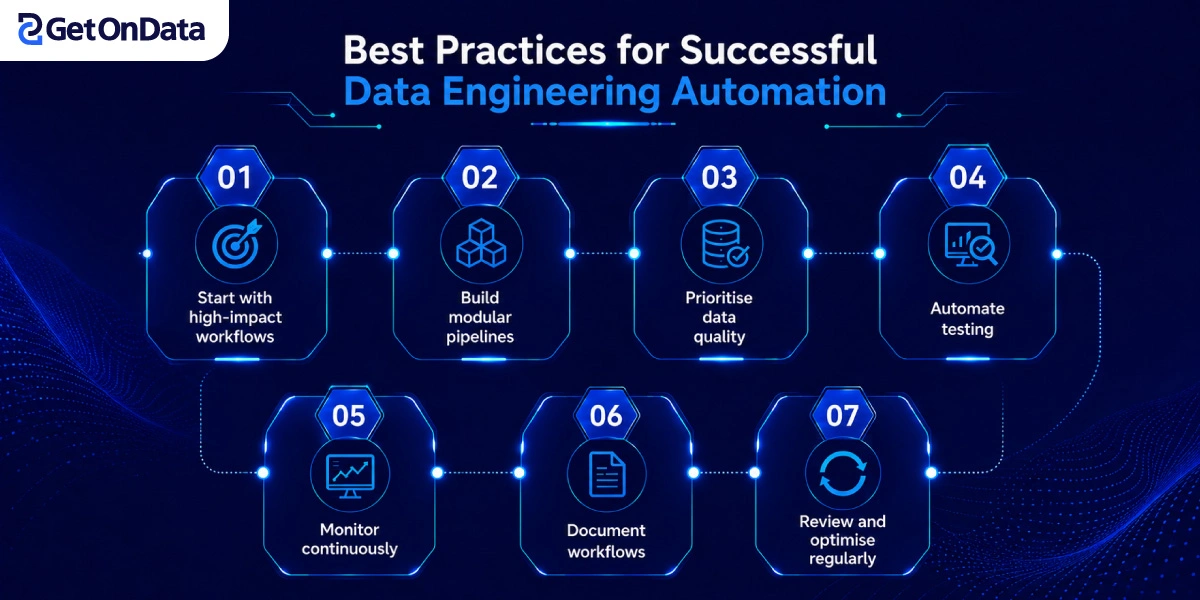
Putting the machinery in place is the easy part, but for real effectiveness, one cannot ignore the development and operational aspects behind the scenes. The following are the recommended guidelines for a proper automation process.
➔ Start With High-Impact Workflows
Pick the work processes where most of the team’s capacity is going to be spent as well; these should be automated first. Success in the early phase of automation will show the effectiveness of automation across the whole team.
➔ Build Modular Pipelines
You can design your own components which you can use repeatedly in building your pipelines instead of creating everything from scratch. Modular design is the easiest for the maintenance and the expansion of a system.
➔ Prioritize Data Quality
You shouldn’t be surprised if at first sight it feels like there is something wrong, because there was no quality check before the data was automatically transformed and cleaned. Put data verification in place all along the pipeline and also make a very clear definition for the action to take in the case of a failed validation.
➔ Automate Testing
Test cases must be automated, starting from transformations to data quality rules, covering schema consistency, dependencies, and data rules. Running tests regularly helps to detect an issue or change before releasing the updated product to the market.
➔ Monitor Continuously
Having dashboards and alerts will enable understanding of your overall pipeline performance, and these are tools on which the monitoring activities should be built, covering both the technical side and the data-related side.
➔ Document Workflows
Having good documentation means that any one person will understand the workings of the process. That person also has the right knowledge to handle any unexpected occurrences and can take corrective measures. The documentation should include logic behind the pipeline, dependencies, ownership, recovery plans, and security measures.
➔ Review and Optimize Regularly
Changes in technology as well as the company’s expectations are inevitable in the long run. The process through which the company reviews its operations regularly helps to eliminate those that don’t help the business, improve the performance of ones that do, and take the steps where automation should be introduced or not if it does not really help the business.
The company can use data engineering consulting services in addition, especially when it is seeking advice or expertise for expanding automated systems within a complicated set of environments.
Also Read: Best Data Engineering Tools for Building Scalable Data Pipelines
How Data Engineering Automation Supports AI-Ready Data Platforms
AI systems are quite dependent on data in terms of accuracy, availability, and freshness. Manually running data processes could cause time delays, leading to problems in the AI model training process and even poor performance of the AI application in general.
Data engineering automation creates a reliable data pipeline to flow trusted data. It can also be a means, for instance, to bring in new customer data automatically, process it, and load it directly. Quality checks that are running continuously identify potential problems before they can harm your AI models and cause delays.
With AI in data engineering automation, engineering teams gain the ability to detect anomalies, analyze workloads, optimize pipelines, as well as identify potential problems early through predictive analysis.
Concurrently, the automation of data engineering by artificial intelligence can cut down on manual labor and allow teams to handle data problems faster. Massive-scale data engineering automation that is also efficient provides the right setting for machine learning, which typically requires large amounts of data and rapid processing. Together with good governance and monitoring capabilities, the use of automation lays the groundwork for robust AI-ready data platforms.
Firms with high technical requirements may be able to get support from a data engineering consulting company or team up with experienced data engineering professionals to set in train architectures that are both current and future-ready for AI.

Ready to Build a Smarter Data Engineering Strategy with Automation
You can get there by examining your current procedures, outlining your targets, recognizing the areas with repeated tasks, and making a list of suitable technologies. The best tools for data engineering automation should match actual business needs and support reliable, scalable operations. Choosing tools aligned with real business needs leads to dependable and scalable data engineering operations.
Expertise provided by a data engineering consulting company will be a major asset when it comes to pinpointing where automation can be introduced, eliminating sources of risk, and enhancing procedures. Having data engineering experts and data engineering consulting services at hand, the business can build solid data processes. A well-deployed data engineering automation strategy not only saves time from doing things manually but also increases speed and lays the groundwork for better analysis and AI.

