
Big data has evolved from a technology initiative into a business necessity. Today’s companies utilize extensive data ecosystems for optimized decision-making, streamlined operations, enriched customer experiences, and fostering AI-enabled innovations. With all this in mind, knowing the costs associated with big data before implementing a data strategy is important to having a workable budget and limiting unforeseen costs.
Several factors determine the costs associated with big data in 2026. These include the type of data infrastructure adopted, the size of the data, the ease or complexity of data integration, the level of data protection and privacy, data interpretation, big data analytic techniques, and the extensibility of big data systems. Enterprises that invest in custom data analytics solutions have a competitive advantage because these systems are built to address specific operational and reporting challenges as well as growth targets.
Demand for advanced analytics is moving faster than before as organizations pour more money into AI and data technologies. By 2026, global investment in AI is estimated to reach $2.59 trillion with a 47% year-over-year increase.
So, business leaders have to look beyond just the setup costs; they should also ask what kind of long-term payoff comes from investments in infrastructure, integration, maintenance, training, and ongoing system upkeep.
This guide looks at the primary drivers of the high costs of big data and advanced analytics in 2026 and offers budgeting recommendations and actionable steps for organizations to manage the costs and risks of data and analytics projects relative to the potential benefits.
⊛ Why Businesses Are Investing in Big Data Solutions in 2026
Organizations want to move faster on decisions, generate AI-driven insights, identify new expansion chances, and also improve day-to-day operations. At the same time, they’re trying to hold a stronger edge in markets that keep changing.
⊛ What Determines Big Data Implementation Costs?
The costs associated with big data implementations are determined by the scope of the project, the data and its complexity, the technology stack, integration, infrastructure, and the human capital necessary for productive implementation.

What Is Big Data Implementation?
Big data implementations involve the large-scale collection, storage, and analysis of data for the purpose of generating insights. Many organizations partner with big data analytics service providers to create flexible, scalable systems for continued growth and innovation.
◈ Core Components of a Big Data Ecosystem
The successful integration of big data analytics involves the collection of large and diverse data sets, the construction of secure storage environments, sophisticated analysis and processing capabilities, and the placement of visualization tools and dashboards to guide and direct business processes.
◈ Typical Big Data Implementation Process
The implementation of big data typically adheres to a particular process, from identifying objectives, integrating disparate data, to deploying both supporting infrastructure and analytical tools, and finally, the commitment to performance optimization.
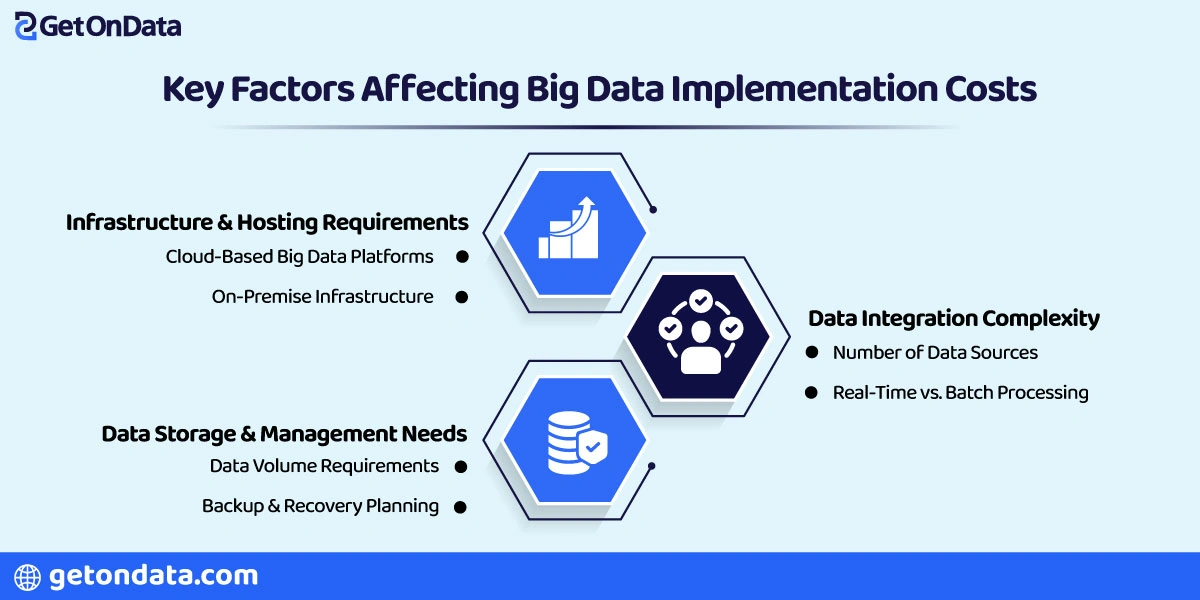
Key Factors Affecting Big Data Implementation Costs
Business needs, choice of infrastructure, integration complexity, security, and scalability all factor into the big data implementation cost. The choice of a single technology can impact cost, deployment timeline, and the cost to run the system in the long run.
➤ Infrastructure and Hosting Requirements
The choice of big data infrastructure can define the state of the business, influence the level of both initial and continuing investments, and impact the costs associated with the environments for storage, computing, networking, security, and maintenance.
➥ Cloud-Based Big Data Platforms
Cloud-based big data platforms let organizations grow capacity as demand changes, so they avoid heavy initial infrastructure spend. In many cases, the managed services approach cuts back on maintenance chores, while still keeping room for changes in business goals and analytics needs.
➥ On-Premise Infrastructure
On-premise deployment means organizations typically invest a lot in servers, storage systems, networking gear, and security controls. Beyond that, teams have to oversee the infrastructure themselves, which boosts admin work and creates longer-term operational obligations.
➥ Data Integration Complexity
Joining disparate business systems is a time-intensive effort that requires a lot of planning based on the transformations and the amount of data validation that would need to be performed. The more complicated the integrations, the more effort will required, and the more expensive the project will become.
➥ Number of Data Sources
When you connect CRM platforms, ERP systems, third-party applications, and operational databases, it can make the whole implementation feel a bit more complex. Not because it’s impossible, but because every extra data source usually means mapping, transformation, validation checks, and ongoing monitoring, so the data stays reliably accessible in practice.
➥ Real-Time vs. Batch Processing
On the other hand, real-time analytics environments need continuous processing support and a more robust infrastructure, which tends to raise costs. Batch processing is often more economical, yet it can fall short when the business needs decisions that are time sensitive, or at least that arrive close to the moment.
➤ Data Storage and Management Needs
Effective data handling comes down to planning storage capacity, setting retention policies, picking backup approaches, and also recovery routines. As overall data amounts keep growing, organizations must ensure accessibility, reliability, and budget across the entire data environment.
➤ Security, Compliance, and Governance
Keeping sensitive information safe needs solid security controls, regulatory compliance, and a clear, well-defined governance setup. Companies have to set up guidance around who can access data, how quality management is handled, how risks get mitigated, and who is ultimately accountable, so customers can trust them and things stay operationally intact.
Also Read: Top Big Data Analytics Companies in the USA Driving Innovation
Big Data Implementation Cost Breakdown by Project Phase
Big data projects usually need investments along several implementation stages, not just one step, but a whole chain of work. So, organizations that want end-to-end data analytics services and solutions should think about budgets very carefully, because each phase adds much to the total success and the final cost.
➣ Discovery and Planning Phase
This phase focuses on gathering requirements, identifying the business objectives, defining success metrics, then crafting a set of implementation strategies and ultimately designing a scalable architecture that matches the technology investments with the organization’s goals.
➣ Data Engineering and Integration Phase
In the Data Engineering and Integration phase, data engineers design pipelines, set up ETL or ELT flows, blend several systems, and establish dependable data moving mechanisms so the information stream stays consistent, accurate, and easy to reach.
➣ Analytics and Reporting Development
Analytics and reporting development is the work of building dashboards, setting up KPIs, tuning business intelligence platforms, and creating a reporting framework that turns raw data into usable, actionable insights for stakeholders. It feels a bit like translating numbers into something the team can actually use.
➣ Testing and Quality Assurance
Testing ensures data accuracy, overall system reliability, security compliance, and performance stays really optimal. The validation steps also identify issues early on, so operational risks drop noticeably, and you avoid expensive corrections after the deployment.
➣ Deployment and User Adoption
A successful deployment usually means the production rollout, user training, adoption planning step, and go-live support right after. Organizations tend to get more value when their employees feel confident using analytics tools.
Hidden Costs of Big Data Implementation
Many organizations focus on deployment expenses while quietly overlooking the ongoing operational costs. Getting a grasp on these unseen outlays is really essential if you want to estimate the cost of big data implementation with any accuracy and keep the whole long-term project sustainable.
➔ Ongoing Maintenance and Support
Big data environments need ongoing monitoring, software updates, performance tuning, and troubleshooting, too. If there isn’t any constant support, organizations can end up with system inefficiencies, unexpected downtime, security weaknesses, and reduced analytics effectiveness.
➔ Data Governance and Compliance Management
Governance initiatives include regular audits, data quality monitoring, and policy enforcement, along with compliance reporting. They help keep data usage trustworthy while also lowering regulatory risks and operational inconsistencies.
➔ Employee Training and Change Management
Successful adoption really depends on educating users, giving ongoing support, and developing analytical skills. When teams are trained well, they can use data platforms more effectively and, in the end, unlock greater business value.
➔ Scalability and Future Growth Requirements
As organizations expand, data sources, infrastructure enhancements, and more advanced analytics capabilities are required. Thinking ahead for future growth, in a proactive way, helps avoid costly system limitations later on and the disruptive upgrades.
Big Data Implementation Models and Their Cost Impact
The type of Big Data model your project adopts greatly affects the cost coverage, amount of resources employed, level of scalability, and how you allocate management duties. A model that meets the organization’s operational needs and preferred growth level is best suited.
⇒ In-House Big Data Implementation
All the components of the Big Data environment, teams, governance, and support infrastructure are built, managed, and operated by the organization itself.
◉ Advantages
With an in-house build, you get full control over the infrastructure, security policies, and the actual workflows, too. The internal teams tend to gain a deep system familiarity, and that results in making it easier to do sharper customization and also keep tighter operational visibility.
◉ Challenges
Building internal capabilities requires direct investment in human capital and structural frameworks. When constructing internal capabilities, dealing with expertise gaps and the allocation of finite resources can also extend timelines and add complexities.
⇒ Working with a Big Data Consulting Partner
Consulting partners fill the gap of in-house expertise, provide structured implementation, and offer technical resources. All of these help organizations realize faster big data implementations and reduce the operational risk of inadequate project execution.
◉ Advantages
The use of a skilled consultant brings established frameworks and technical and sector-specific knowledge. This allows issues to be resolved and projects to be completed rapidly and with minimal implementation risk.
◉ Considerations
Companies must evaluate the vendors’ skill sets, knowledge of the sector, support structure, and flexibility. The success of a project relies heavily on sustained, quality, ongoing support after the initial deployment.
How to Optimize Big Data Implementation Costs
Getting a handle on implementation costs means doing strategic planning, phase execution, plus making tech choices that are in sync with the actual business goals. Companies that manage investments well often boost their ROI while at the same time reducing unnecessary spend.
➞ Start with Clear Business Objectives
When objectives are clearly defined, organizations can focus their resources on the highest impact initiatives, set measurable outcomes, make better decisions about investments, and also avoid scope expansion that tends to unnecessarily expand implementation costs.
➞ Implement Big Data in Phases
A phased implementation approach can reduce financial risk, deliver incremental value, and help organizations fine-tune their strategies while scaling capabilities, based on shifting business requirements.
⦿ Phase 1 – Build the Data Foundation
Start with reliable data gathering routines, a centralized storage setting, governance rules, and enough integration pathways so you get a solid base for future analytics work.
⦿ Phase 2 – Develop Analytics Capabilities
Focus on creating a reporting system, dashboards, and visual discovery tools, so business users get practical insights, which help them decide more quickly and gain better day-to-day operational sight.
⦿ Phase 3 – Scale with AI and Advanced Analytics
Predictive analytics, machine learning, and automation can provide deeper, actionable insights and enhance the reliability of forecasts. Advanced technologies can facilitate and fuel innovation through information and analytics.
✦ Select the Right Technology Stack
Choose technologies that enhance seamless operational flexibility and integration at scale. A properly aligned tech stack will mitigate future migration costs while accommodating the analytics and growth requirements of the business.
Also Read: Data Analytics Maturity Models: A Step-by-Step Business Guide
Common Mistakes That Increase Big Data Costs
Many organizations exceed their planned budgets because of avoidable missteps during implementation. Identifying and handling issues early on helps with operational efficiency, lowers exposure to risks, and in the end maximizes the project’s overall value.
➡ Lack of a Clear Data Strategy
Lack of a clear strategy leaves organizations to undertake isolated initiatives, invest in unnecessary technologies, and struggle to connect their data projects to actual business goals.
➡ Overengineering the Solution
Designing unnecessarily complex architectures beyond business needs drives up costs, expands deployment timelines, and creates a maintenance burden, all while failing to provide adequate business value.
➡ Ignoring Data Quality Challenges
Addressing data quality issues is essential for maintaining accurate reporting and reliable analytics, and for sustaining efficient and effective decision-making. Ignoring data quality issues will lead to costly corrective measures later in the project.
➡ Underestimating User Adoption Requirements
Even advanced analytics platforms often don’t deliver much value when users don’t get the training part right, or there’s low engagement. Solid adoption strategies help push broader use, boost productivity, and, in turn, speed up the whole business impact.
Big Data Trends Influencing Implementation Costs in 2026
Emerging tech keeps reshaping implementation approaches, and also shifts investment priorities a bit. If organizations get a handle on these patterns early, they can help anticipate future expenses and then make better long-term calls.
✧ AI-Powered Data Analytics Platforms
AI-powered platforms automate the data analysis, anomaly spotting, prediction, and even decision support. They help organizations generate insights at a quicker pace, while also reducing manual analytical workload.
✧ Data Fabric Architectures
Data fabric architectures connect distributed data environments with one unified access framework, and they help with data availability, cut down on siloed things, and make enterprise-wide information management a bit easier overall.
✧ Real-Time Analytics Adoption
Many people want quick visibility, so companies are putting money into real-time analytics platforms that help with fast decisions, day-to-day responsiveness, and even better customer experiences.
✧ Industry-Specific Big Data Solutions
Purpose-built solutions, made for certain industries, accelerate deployment, help with compliance alignment, and provide analytical capability that is tuned to the specific operational needs, plus the actual business objectives.
How to Choose the Right Big Data Implementation Partner
Choosing the right implementation partner affects overall project success, future scalability, risk management, and even the long-run return on investment, so it is a big deal. Organizations should put focus on expertise, steadiness, and strategic fit rather than just speed.
➥ Evaluate Technical Expertise
Consider a partner’s experience with data engineering, data/cloud security, analytics, and large-scale implementations, among a few others, to determine if they have the business acumen to address your needs.
➥ Questions to Ask Before Hiring
Evaluate the project criteria and ask the right questions to identify potential vendors with the relevant industry experience and the capacity and commitment to co-develop and support scalable and secure solutions with a successful track record.
➥ Key Success Indicators
The best implementation partners deliver successful projects. They have the technical skills and communication skills to meet your needs. In addition, they provide flexible and durable solutions and a high level of support, all of which are critical to your success.
Ready to Build a Cost-Effective Big Data Strategy?
Building a successful big data strategy goes beyond investing in technology. Organizations need to consider future growth, align their data solutions with business goals, and select the right value-driven solutions. Working with experienced data analytics service providers can help mitigate the risks of implementation and drive efficiency and results. Wise decisions regarding infrastructure, analytics, and scalability help businesses better manage data spend and strengthen the opportunity for sustained innovation and competitive advantage.

