
Organizations are looking for advanced solutions to transfer fragmented data into valuable metrics. Whether you are a startup or an enterprise owner, before you start your BI journey, it is necessary to understand the implementation cost. Power BI is a popular BI platform in 2026, and businesses of all sizes are using it for analytics, reporting, and data visualization. The reason behind the popularity of Power BI consulting is that it is affordable compared to other BI tools. As per Microsoft, there are 3 lakh 75 thousand companies globally using Power BI to measure data and make informed decisions.
Before you start implementation, you must know about the hidden costs such as storage, maintenance, development & integration. Power BI dashboard development involves pulling data from multiple sources and transferring data into structured models. The final cost of implementation is based on the scope of the project, complications involved, and data sources. Let’s take a brief preview of the complete Power BI implementation guide & cost shared by a Power BI consulting company.
How Much Does Power BI Implementation Cost in 2026?
◈ Basic Power BI Implementation
For startups or small enterprises that require simple reporting features, a minimal Power BI setup is appropriate. One or two data sources are usually connected, a few interactive dashboards are developed, standard data models are implemented, and a small number of users are supported in these projects.
Basic systems are typically installed faster because they involve less data manipulation and basic visualizations. Depending on the number of dashboards, reporting needs, and customization needed, the cost could be US$3,000 and US$10,000. This choice offers a reasonably priced foundation for the use of BI.
◈ Mid-Level Power BI Implementation
Growing companies that need advanced reporting and analytics capabilities are the target audience for mid-level Power BI consultancy. These projects usually involve implementing complicated DAX computations, integrating several data sources, designing bespoke dashboards, setting up automated data refreshes, and offering user support and training.
Data transformation, security configuration, and speed optimization may require additional work. Depending on the complexity of the project, the number of users, and the integration needs, the implementation cost could be US$10,000 and US$40,000. This phase of deployment facilitates better corporate decision-making and offers more scalability.
◈ Enterprise Power BI Implementation
Large businesses with numerous business segments, complex reporting needs, and vast data ecosystems can choose this. Complex data architecture, cloud, ERP, and CRM platform connection, Microsoft Fabric integration, security, RBA, and continuous maintenance and support are all common features of these projects.
Large-scale data modeling, AI-powered insights, and predictive analytics may also be used in enterprise implementations. Depending on the complexity, infrastructure, custom development, regulatory requirements, and long-term support needs, the Power BI experts charge from US$40,000 to US$200,000.
What Is Included in Power BI Implementation?
➔ Business Requirement Analysis
Start with understanding your business goals and reporting requirements. The Power BI consulting company collaborates with stakeholders to establish precise reporting objectives, determine the most crucial KPIs, and collect user requirements from various departments. Data sources, reporting priorities, and dashboard expectations are all determined during this discovery phase. A carefully planned implementation roadmap guarantees that the project remains in line with business objectives. It minimizes development delays and provides valuable insights that facilitate improved decision-making.
➔ Data Integration and Preparation
Implementing Power BI refers to combining data from several sources, including databases, cloud apps, CRM systems, ERP platforms, and spreadsheets. To eliminate duplicates, fix inconsistencies, and increase accuracy, the gathered data is cleaned, processed, and standardized. After that, data models are created to facilitate effective reporting. Additionally, automated data refresh schedules are set up, guaranteeing dashboards always show the most recent data without the need for manual changes.
➔ Dashboard and Report Development
Creating interactive and user-friendly Power BI dashboards that are suited to business requirements is the main goal of this phase. Power BI specialists create attractive reports with charts, filters, and unique visualizations. They also develop DAX computations for complex metrics. Because dashboards are built for both desktop and mobile devices, users can get real-time insights at any time. The aim of a BI implementation expert is a great user experience and quick performance.
➔ Testing, Deployment and Training
Power BI dashboards are thoroughly tested prior to deployment in order to confirm data quality, report functionality, and overall performance. Security settings and user permissions are set up to guarantee that sensitive data is accessed appropriately. Administrators and end users can comfortably explore dashboards and produce insights with the help of training sessions.
Also Read: List of Power BI Analytics Services for Business Intelligence Implementation
Power BI License Costs in 2026
✧ Power BI Desktop
Microsoft’s free report-building tool, Power BI Desktop, lets users connect data, build models, and create interactive dashboards. Individual analysts, developers, and business users who must create and test reports before submitting them to the Power BI Service will find it perfect.
Although it offers extensive modeling and data visualization capabilities, report-sharing options are restricted in the absence of a cloud license. For businesses looking to explore Power BI, Power BI Desktop is an ideal place to start because it doesn’t require a license.
✧ Power BI Pro
Businesses that need cloud-based analytics, team collaboration, and report sharing should choose Power BI Pro. Because the license is priced per person, it is a convenient choice for small & mid-size firms.
Users may set up scheduled data refreshes, publish reports, work together in shared workspaces, and safely access dashboards from any location. To choose the best licensing plan and embrace the potential of Power BI, many companies work with a Power BI consultancy.
✧ Power BI Premium Per User
For businesses with more complicated reporting and analytics needs, Power BI Premium Per User offers advanced features. Larger data models, AI-powered features, structured reports, improved performance, and advanced data preparation tools are all supported.
Analysts and decision-makers who require enterprise-grade capability without having to invest in dedicated Premium capacity can use this license. PPU is a suitable choice for expanding companies with complex BI requirements since it provides a balanced mix between price and cutting-edge functionality.
✧ Microsoft Fabric and Power BI Embedded
Enterprise-scale analytics and customer-facing reporting solutions are the focus of Microsoft Fabric and Power BI Embedded. These services employ capacity-based pricing in place of per-user licensing, enabling companies to scale resources in response to workload demands.
Measure capacity, storage, data processing volumes, deployment design, and the number of concurrent users; all affect enterprise Power BI implementation cost analysis. These solutions are perfect for businesses that need high-performance reporting across numerous departments, apps, and external users, embedded analytics, and large-scale data management.
Complete Power BI Implementation Cost Breakdown
⇒ Consulting and Planning Cost
The planning and consultation phase directly affects the total project cost and establishes the foundation for a successful Power BI installation. In order to comprehend corporate objectives, determine reporting requirements, and establish KPIs, this step usually involves discovery workshops.
In addition, consultants build the technological architecture, create a thorough project roadmap with deadlines and goals, and develop a BI strategy. Businesses that make significant planning investments typically experience fewer implementation issues, less rework, and a more seamless deployment process.
⇒ Data Integration Cost
The quantity and complexity of data sources that must be connected to a Power BI determine the cost of data integration. To build a single reporting environment, businesses frequently combine databases, cloud apps, ERP systems, CRM platforms, and third-party software.
Data transformation, custom connectors, API development, and setting up on-premises data gateways for secure access may result in additional expenses. The implementation effort increases with the fragmentation of the current data infrastructure. Investing in reliable data integration guarantees real-time, accurate, and consistent reporting throughout the company.
⇒ Dashboard Development Cost
The number of dashboards required, the complexity of the reports, and the level of customization all affect dashboard creation costs. Compared to executive dashboards with extensive analytics, dynamic visualizations, and simple operational dashboards usually take less time to construct.
Custom graphics, intricate data models, complex DAX computations, row-level security, and speed optimization all increase project costs. For businesses looking to expand through data, well-designed dashboards are a great investment. It increases user adoption, streamlines decision-making, and offers insightful business information.
⇒ Training and Support Cost
A successful Power BI implementation requires training and continuing support, which should be covered in the project budget. End-user training, administrator training, user manuals, technical documentation, and knowledge transfer sessions are usually included in the price.
As business needs change, many businesses also spend money on post-launch support for product improvements, performance optimization, debugging, and dashboard maintenance. Ongoing support guarantees that customers can use Power BI with confidence, promotes greater adoption rates, and assists companies in optimizing the long-term return on their BI investment.
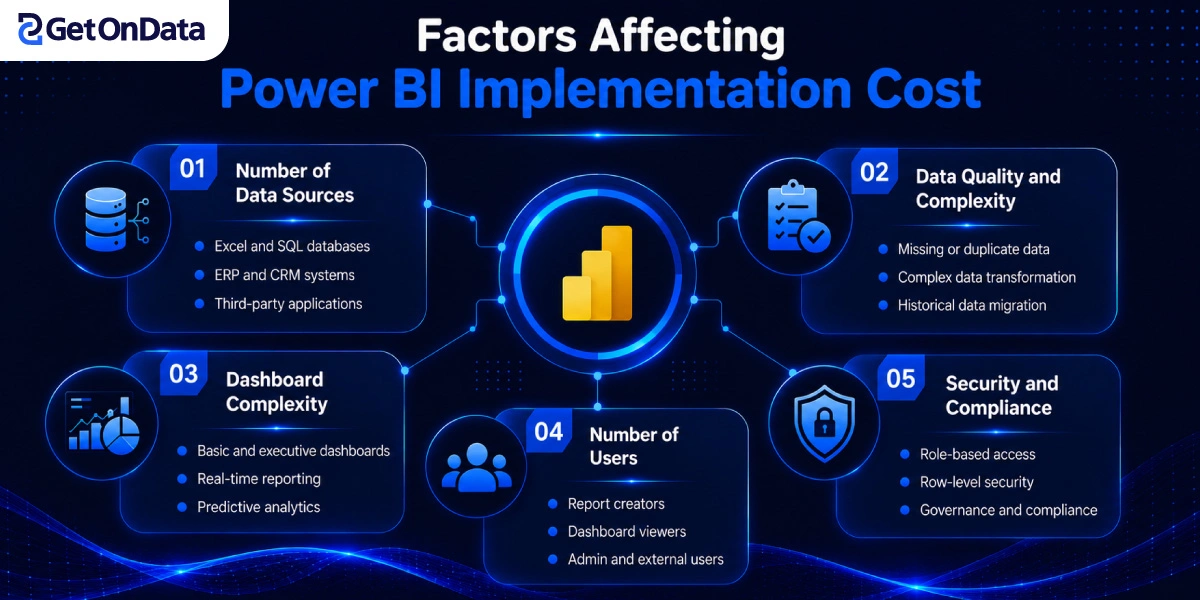
Factors Affecting Power BI Implementation Cost
➢ Number of Data Sources
The implementation cost of Power BI is greatly impacted by the quantity of data sources connected to Power BI. Data from Excel files, SQL databases, ERP systems, CRM platforms, cloud apps, and 3rd-party software must frequently be integrated by organizations.
To guarantee smooth data flow and consistency, each new source needs to be configured, validated, and tested. Businesses can combine data from many systems and produce precise, real-time dashboards for well-informed decision-making with the help of a well-integrated data ecosystem.
➢ Data Quality and Complexity
The overall implementation effort is largely determined by the quality of the data. Before being used for reporting, poor-quality data, such as missing values, duplicate entries, inconsistent formats, and unstructured datasets, needs to be thoroughly cleaned and transformed.
Project complexity and expenses are also increased by historical data migration, data mapping, and validation. Spending work on clean, trustworthy data preparation increases dashboard accuracy, boosts reporting performance, and guarantees that decision-makers can rely on the insights produced by Power BI across various business units.
➢ Number and Complexity of Dashboards
The more dashboards there are, and the more intricate the reporting requirements, the more expensive it is to integrate Power BI. Executive dashboards with interactive visualizations, real-time reporting, predictive analytics, and unique visualizations demand more development than basic operational reports.
To provide a flawless user experience, advanced dashboards frequently incorporate intricate data models, extensive DAX computations, and speed optimization. To guarantee that dashboards provide insightful and useful information, businesses with highly tailored reporting requirements should budget extra time for development, testing, and improvement.
➢ Number of Users
Implementation and license expenses are directly impacted by the number of customers using Power BI. Different user roles, such as administrators, dashboard monitoring, report producers, and external users who need secure access to reports, must be taken into account by organizations.
Additional workspace configuration, user rights, governance policies, and license management are often required when there are more users. Scalable deployment solutions are crucial for maintaining performance, security, and teamwork as businesses expand. Effective planning supports effective business intelligence throughout the company and guarantees that each user has the proper access.
➢ Security and Compliance Requirements
The cost of implementing Power BI can be significantly affected by security and compliance requirements, especially for organizations that handle sensitive data. Careful planning and configuration are necessary for features like RBA control, row-level security, data governance policies, and audit logging.
Companies in sectors including government, healthcare, and finance may additionally have to adhere to internal security guidelines and legal requirements. By establishing robust security measures, corporate data is safeguarded, compliance is supported, operational risks are decreased, and users are guaranteed to access only the data related to their responsibilities.
Power BI Implementation Pricing Models
⊛ Fixed-Price Model
Organizations with well-defined project needs, deadlines, and deliverables are most suited for the fixed-price approach. Businesses are able to precisely estimate project costs and budgets since the implementation scope, milestones, and desired outcomes are agreed upon prior to creation.
For typical dashboard development, data integration, and reporting projects with little scope modifications, this pricing model offers financial predictability. However, modification requests may result in higher costs and prolong the project’s overall budget and schedule if new features, integrations, or reporting requirements emerge during implementation.
⊛ Hourly Consulting Model
Businesses with changing needs or projects that need flexibility during the implementation process can benefit from the hourly cost of Power BI implementation. Businesses only pay for the actual number of hours worked on tasks like data integration, dashboard construction, troubleshooting, optimization, and user training.
When the project’s scope constantly shifts in response to stakeholder input, this model performs well. The final implementation cost is determined by the total number of consulting and development hours needed to properly execute the project, even though it provides more flexibility than a fixed-price engagement.
⊛ Dedicated Team or Monthly Retainer
For businesses that need ongoing Power BI development, improvements, and long-term maintenance, a dedicated team or monthly retainer model works well. Companies get continuous access to skilled Power BI experts who monitor dashboard enhancements, the development of new reports, data integration, performance optimization, and system upkeep.
As reporting requirements change, this engagement model also includes proactive technical support, problem-solving, knowledge exchange, and strategic direction. It guarantees that companies have dependable knowledge to continuously enhance their BI environment and maximize long-term value while providing predictable monthly costs.
Hidden Power BI Implementation Costs
➞ Poor data quality
It requires more cleansing, validation, transformation, and troubleshooting; poor-quality data raises implementation costs. Creating accurate dashboards and trustworthy business insights requires addressing missing, duplicate, or inconsistent records.
➞ Additional user licenses
More Power BI licenses can be required when more workers need access to reports and dashboards. Over time, increasing user access may result in higher continuous subscription and administrative expenses.
➞ Data warehouse development
A consolidated data warehouse is necessary for some businesses prior to Power BI implementation. It takes more time, investment, and resources for development and maintenance.
➞ Custom connector development
It could be necessary to create bespoke connectors in order to integrate legacy systems or unsupported apps. These custom integrations raise the complexity of implementation, the amount of work required for development, the need for testing, and the cost of ongoing maintenance.
➞ Microsoft Fabric capacity upgrades
Microsoft Fabric capacity may need to be increased due to growing data volumes and user activity. Although upgrading resources boosts scalability and performance, it also raises continuing infrastructure and license expenses.
➞ Scope changes
After development starts, adding new dashboards, integrations, or reporting requirements frequently leads to longer deadlines, more consultation hours, and greater implementation costs than expected.
➞ Employee training
It takes time and money to train administrators and end users. Employees with proper training increase adoption, lower support requests, and optimize the Power BI implementation’s long-term benefits.
➞ Ongoing maintenance
In order to update dashboards, track data refreshes, fix problems, and adapt to shifting business needs, Power BI setups need routine maintenance, which results in ongoing operating and support expenses.
➞ Performance optimization
Continued technical expertise is required to improve query speeds, optimize dashboard performance, and refine data models. Faster reporting is ensured by these actions, but long-term implementation and support costs are increased.
Also Read: Top Power BI Partners in UAE for 2026 Delivering Data Driven Solutions
How to Reduce Power BI Implementation Costs
➥ Define Clear Requirements
Reducing unnecessary development expenses and project delays can be achieved by precisely specifying business needs prior to implementation. Organizations should prioritize KPIs, determine which dashboards are most crucial, and thoroughly record their reporting goals.
Frequent requirement changes, which frequently result in longer implementation times and higher costs, can be avoided by clearly defining the project’s scope. Development teams may concentrate on producing high-value dashboards that support business objectives while keeping the project under budget and on schedule by avoiding unnecessary features and customizations.
➥ Start With a Pilot Project
An affordable method of validating Power BI prior to a full-scale implementation is to start a pilot project. Companies should start with a single high-value use case that fulfills a crucial reporting requirement and produces measurable outcomes.
Organizations may assess data quality, test platform functionality, get user input, and spot possible problems early with this method. Additional dashboards and business units can be introduced gradually when the trial is successful, lowering risks and preventing unnecessary installation expenses.
➥ Improve Data Quality Early
Enhancing data quality prior to deployment minimizes development work and avoids reporting inaccuracies. Before connecting sources to Power BI, businesses should eliminate duplicate records, standardize data formats, fix missing or inconsistent information, and verify data accuracy.
Assigning data owners promotes accountability across departments and helps in the long-term maintenance of data quality. Clean, trustworthy data makes integration easier, enhances dashboard performance, and minimizes implementation debugging. It gives decision-makers confidence in the insights produced by business reports.
➥ Implement Power BI in Phases
Organizations may reduce expenses and provide results faster by implementing Power BI in phases. Priority dashboards for key departments can be introduced first, and thereafter teams and reporting requirements can be added.
A phased strategy lowers implementation risks, maintains a realistic project scope, and enables the application of lessons acquired from previous phases to enhance subsequent deployments. Additionally, it distributes the investment over several stages, which facilitates budgeting and guarantees that each step produces measurable benefits.
➥ Select the Right License
Organizations can meet reporting standards and avoid unnecessary licensing costs by selecting the right Power BI license. Assigning the appropriate licenses to each position is ensured by identifying report creators, dashboard readers, administrators, and external users. Organizations can maximize their Power BI investment while preserving scalability for future business growth by avoiding premium capabilities that are not necessary.
How to Choose a Power BI Implementation Partner
✦ Review Power BI and Microsoft Fabric experience
Select a partner who has a track record of successfully implementing Microsoft Fabric with Power BI. Power BI specialists with experience can create scalable analytics solutions, lower implementation risks, and produce business results more quickly.
✦ Check relevant industry projects
Examine the provider’s background in your sector and ask for references or case studies. Consultants with industry-specific experience are better equipped to comprehend reporting issues and provide more accurate business intelligence solutions.
✦ Evaluate data engineering capabilities
Examine the partner’s proficiency with data warehousing, ETL procedures, modeling, integration, and transformation. Power BI dashboards that are accurate, reliable, and execute well are guaranteed by strong data engineering capabilities.
✦ Request a detailed pricing breakdown
Request a clear cost estimate that includes consulting, development, training, license, maintenance, and support. A thorough pricing breakdown promotes better project budgeting and helps prevent unforeseen costs.
✦ Review training and support services
Make sure the implementation partner offers thorough post-deployment support, technical documentation, administrator guidance, and user training. Continuous support maximizes long-term value, enhances adoption, and promptly solves problems.
✦ Confirm scalability and long-term assistance
Choose a partner who can provide additional dashboards, integrations, performance optimization, and continuous maintenance to accommodate future expansion. Long-term support guarantees that your Power BI environment adapts to changing business requirements.

Ready to Estimate Your Power BI Implementation Cost?
Understanding Power BI implementation cost is a little challenging initially, but breaking it down according to your needs could make it easier. By carefully choosing the ideal plan described above, you can obtain powerful analytics and insights.
Hiring a Power BI consulting partner makes a difference. They will help you build efficient dashboards & integrating AI-driven advanced analytics. They will make sure that you get the maximum value from your Power BI investment without additional charges.

