
Business analytics is changing the face of decision-making in organizations. It’s not a ‘Gut feeling’ or ‘guesswork’ anymore in companies. They instead rely on data to inform every big decision, ranging from resource planning to customer targeting. This transition is occurring across industries, and it’s happening quickly.
By 2025, over 78% of global enterprises will have at least one BI/analytics platform in place, and 84% of executives state BI/analytics will be essential for their enterprise digital transformation journey.
Medicine, banking, and retail are the three primary sectors driving such shifts. Every one of them produces huge amounts of data every day. All of them are under extreme pressure to cut costs, boost results, and remain competitive. And each of them relies heavily on reliable, fast, and scalable business intelligence analytics to make that happen.
What is Business Intelligence?
➔ Definition and Core Components
Business Intelligence involves collecting, structuring, and examining the information to make better decisions in an organization. It converts raw data into clear, actionable insights that teams can use.
In most cases, BI is concerned with three fundamental areas. First, data collection and integration: consolidating data from various sources such as CRMs, ERP systems, spreadsheets, and databases into a single location. Second is data analysis, which involves using statistical models and algorithms to look for patterns, trends, and anomalies. Third, dashboards, reporting, and visualization mean displaying results in charts and graphs so that all team members can easily understand. As those elements function synergistically, companies formulate choices based on what the data actually shows.
➔ Key BI Tools and Technologies
A lot of tools drive the modern BI environments. At the base are data warehouses, which provide the ability to store structured data from all parts of the organization and query it in volume. On top, tools such as Power BI, Tableau, and Looker transform data stored in the warehouse into visual dashboards and reports.
AI-powered analytics is being integrated into these platforms. The use of machine learning in BI Dashboards has grown by 48% in 2025, while AI-assisted BI has saved 35-40% of manual data preparation time. This translates to less time spent cleaning data and more time spent creating insights.
Business intelligence data warehousing is the foundation of the entire ecosystem. Even the best BI tools will not give consistent results without a clean and well-structured warehouse.
➔ Why BI is Essential for Businesses
The core argument for BI is simple: quicker decision-making equals better results. Firms utilizing analytics-guided strategies realize an average ROI of 127% within 36 months of deployment, and data-driven organizations are 23 times more likely to be gaining clients, 6 times more likely to retain them.
In addition to ROI, BI also boosts operational efficiency, cuts down on wasted resources, and offers a genuine competitive edge to businesses. It also alters the way teams operate. With equal access to the right information, alignment improves, and silos are eliminated.
Key Benefits of Business Intelligence Across Industries
From ensuring that a retail outlet never sells out of trendy items to enabling a restaurant to enhance dining service, real-time insights give businesses the edge to stay ahead of the curve. Let’s grasp the benefits of business intelligence solutions, which are broadly applicable.
Real-time data insights allow teams to respond to changes as they happen, not days or weeks after the event. A sales team can see a dip in conversions and investigate immediately. A hospital can flag a patient’s risk before it becomes a crisis.
Improved operational efficiency comes from automation and better resource allocation. BI adoption saves an average of 18 to 22% in operational costs thanks to better forecasting and efficiency.
Enhanced customer understanding is one of the benefits of business intelligence tools. By integrating purchase history, behavior data, and feedback, organizations can gain a more comprehensive understanding of their customers’ needs and preferences.
Better forecasting and planning improve team preparation. From forecasting stock shortages to forecasting income, BI makes planning more accurate.
Risk reduction and compliance round out the list. BI platforms identify abnormal patterns, automate audit trails, and ensure organizations comply with regulations, without the burden of manual work.
Benefits of Business Intelligence in Healthcare
In today’s healthcare ecosystem, there are many different types of data being generated from patient records, lab results, and billing activities. All these pieces are collected by the business intelligence tools. These tools, when integrated with AI, provide leaders with rapid insights into patient needs, cost management, and decision-making to enhance overall care.
➥ Improved Patient Care and Outcomes
The benefits of business intelligence in healthcare commence directly alongside those receiving treatment. With BI, clinicians can access patient information in real-time across departments, including lab results, patient vitals, medical history, medication records, and more. That translates to quicker, more informed decision-making for doctors.
Perhaps more importantly, BI allows for personalized treatment. When a BI platform analyzes thousands of patient records, it can help clinicians deliver individualized care plans for different risk profiles rather than applying one-size-fits-all protocols.
➥ Operational Efficiency in Hospitals
Hospitals run on tight margins. Each resource that is not being fully utilized to provide care (an unused operating room, an overstocked supply shelf, a staff member working somewhere else) is costing more. BI takes care of this directly.
BI assists hospitals in optimizing staffing resources in accordance with patient demands in real time. Equipment usage data helps plan repairs plus avoid costly idle periods. This outcome yields highly optimized and productive operation without any decline in care delivery.
➥ Data-Driven Clinical Decisions
Forecasting algorithms are changing the way medical choices are formulated. Today, BI & data warehouse services are used in hospitals to study the health trends of the population, to anticipate the outbreak of diseases, and to identify patients at high risk, before they need emergency treatment.
One reported case: A health system took care to implement early warning alerts using BI and reduced sepsis-related mortality by 18%, while decreasing the average time from diagnosis to treatment from 6.4 hours to 2.1. This is the type of evidence-based decision-making at scale.
➥ Cost Reduction and Financial Management
Billing mistakes, duplicate care, and inefficiency in claims processing cost healthcare organizations a lot of money. BI tackles all of these. Automated revenue cycle dashboards give real-time insights into billing workflows and alert you to billing problems.
Predictive financial modeling also assists hospitals in budgeting more effectively, taking into consideration patient volume trends, payer mix, and the changes in cost-per-case. The end result is a proactive, rather than reactive, financial process.
➥ Regulatory Compliance and Data Security
The healthcare sector is one of the most regulated sectors in the world. To be HIPAA compliant, controls must be in place regarding the storage, access, and sharing of patient information. BI data solutions enable compliance through automated audit trails, role-controlled access to data, and on-demand compliance reporting.
This is not just about avoiding fines. This secure data management not only fosters patient confidence but also serves as a competitive edge for healthcare providers.
Also Read: Top business intelligence company in Dubai delivering scalable BI solutions
Benefits of Business Intelligence in Finance
BI empowers financial teams to leverage their customer information to strengthen relationships and increase sales. It also provides real-time facts for leaders to make quick and smart decisions on market investments. These powerful tools can identify financial risks and fend off cyber threats, ensuring that money remains secure, not just profitable.
◈ Enhanced Risk Management
The financial industry processes a huge volume of sensitive data, and risk management is central to this business. Business intelligence analytics is an important component of fraud detection. BI platforms analyze thousands of transactions per second and flag unusual patterns that human analysts would never catch in time.
BI also enhances credit risk assessment. Lenders are no longer using credit scores alone to create a full risk profile, and this equals better lending decisions and reduced default rates.
◈ Better Financial Planning and Forecasting
Financial teams can make highly accurate financial plans with the help of revenue prediction models based on historical data and external market signals. When leaders can see exactly where money is being used and where it isn’t, budget optimization can happen.
These models are developed by data analytics companies that cater to the financial industry, which rely on structured financial data and AI-driven trend analysis. The outcome is more reliable, more detailed forecasting than the old spreadsheet methods.
◈ Real-Time Reporting and Insights
Financial dashboards provide executives with real-time insights into business operations throughout the company. KPI tracking is real-time revenue, expenses, margin, and cash flow, which are always current and not left until the monthly close cycle.
This velocity is of crucial importance in finance. A portfolio manager who can observe overnight market movements on their dashboard when they log in at 9 AM operates very differently from one who waits for a Tuesday report to understand last week’s data.
◈ Regulatory Compliance
Financial institutions are subject to multiple, overlapping regulations. Automated compliance reporting via BI & data warehouse services lessens the manual burden substantially. Systems pull in the necessary information, process it properly, and provide reports on time, complete with full audit trails.
BI helps you be ready for an audit. Whenever auditors demand paperwork, teams can pull complete, accurate records within moments instead of multiple weekdays.
◈ Customer Insights and Personalization
Data BI solutions allow banking firms to measure client actions on a granular level. Purchase habits, product consumption, and life events are all data points that contribute to personalized product suggestions.
If a bank is aware of a customer’s intention to make a major purchase, it can provide a financing solution. A lifestyle-insurance company can provide tailor-made insurance premiums. This deep customization boosts both loyalty and retention, plus your overall income.
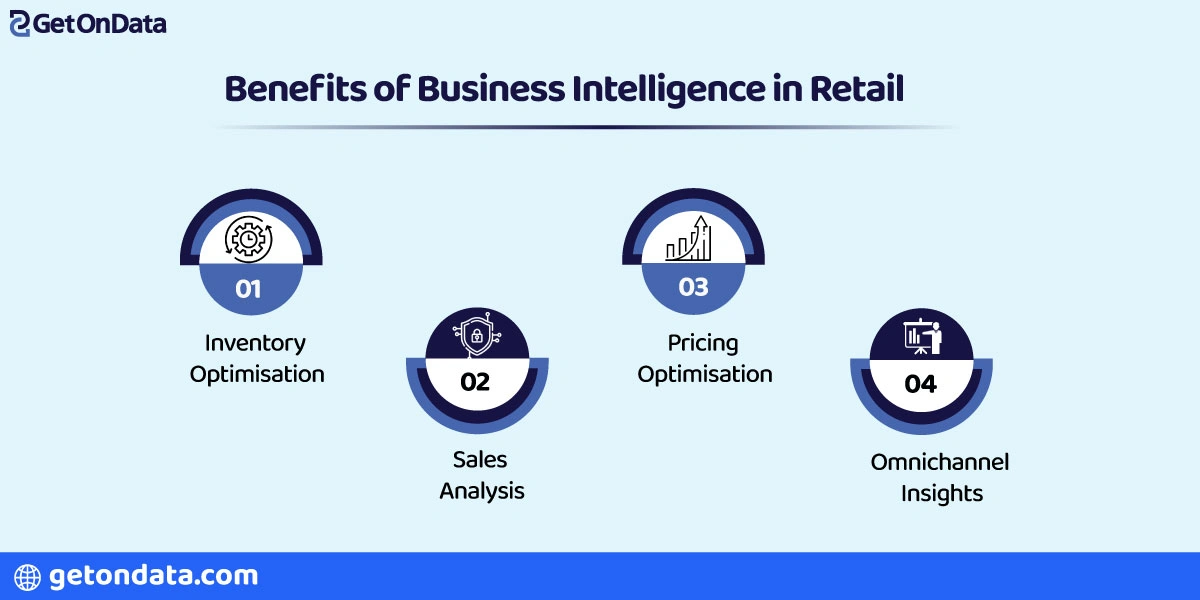
Benefits of Business Intelligence in Retail
Business intelligence removes the guesswork from retail by consolidating information from cash registers, websites, marketing campaigns, and more onto a single, easy-to-read screen. All your data in a single location means your team can easily identify new buying patterns and address issues before they become a crisis. In the end, these tools transform data into action, driving sales, stock control, and repeat visits.
⇒ Improved Customer Experience
The benefits of business intelligence in the retail industry remain visibly obvious regarding shopper experiences. Using BI for personalized product suggestions boosts average order values and conversions. If a customer receives suggestions that are actually to their liking, they end up spending more and coming back more often.
By tracking customer behavior across sessions, devices, and channels, retailers can gain insights into all aspects of the shopping journey, rather than just individual transactions. This view makes every marketing touchpoint more relevant and effective.
⇒ Inventory and Supply Chain Optimization
Retail is very sensitive to inventory issues. Overstocks bind up funds and cause markdowns. Out of stock creates missed purchases plus destroyed trust. BI addresses both by making demand forecasting much more accurate.
Business intelligence data warehousing integrates past purchase figures, yearly trends, advertising schedules, plus external signals like weather or events into unified models. These models forecast demand at the product and location level, enabling buyers to place the appropriate orders at the right time.
⇒ Sales Performance Analysis
Analytics software effortlessly reveals what items generate maximum revenue versus those falling short. Category managers can easily monitor market leaders in each region, observe real-time seasonal trends, and tweak assortment plans accordingly.
Until now, this level of sales visibility was found only in large retailers that had teams of analysts. On the bright side, modern BI platform tools have made it accessible for mid-market retailers, as well.
⇒ Pricing Strategy Optimization
BI-driven dynamic pricing models consider the pricing of competitors, signals of demand, and stock levels, and suggest optimal pricing in real time. Retailers using these models can maintain margin while retaining volume.
BI can also be used to perform competitor analysis. Available at scale, competitor pricing, promotions, and availability are now monitored automatically, providing merchandising teams with a real-time view of the competitive landscape.
⇒ Omnichannel Retail Insights
The modern customer uses several channels to make a purchase, be it online, in-store, or through apps and social media. BI combines data from all of these touchpoints into a single customer view.
This is important because shoppers who browse offline and buy online are two different customers from a silo point of view. Business intelligence analytics connects those dots, revealing the true customer journey and enabling retailers to optimize every step of it.
Real-World Use Cases of BI in These Industries
Predictive medical software assists hospital networks in identifying patients facing high relapse probabilities and takes proactive steps to prevent them before they leave. One leading health network used a BI-powered early warning system to cut sepsis response time by more than two-thirds.
In the financial sector, BI-driven fraud detection has become common at big banks. By analyzing transaction velocity, location patterns, and merchant categories simultaneously, these systems catch fraud that rule-based systems miss entirely.
BI data solutions power retail recommendation engines, which account for a large part of the e-commerce revenues. Amazon has made it very clear that its recommendation engine is responsible for around 35% of all its revenue, which is a direct result of the use of advanced BI on customer behavior data.
Challenges in Implementing Business Intelligence
Implementing BI in your business can reveal the actual challenges, such as time-consuming reporting that hinders leadership from making timely decisions. If your new tools aren’t simple or are a bit too fragmented, your team will ignore them, unintentionally increasing your tech expenses. To avoid these pitfalls, it’s important to have a comprehensive game strategy that combines the appropriate software with a true data-driven culture.
Information quality issues represent our most frequent hurdle. By having documented data governance, companies see a 62% reduction in data analytics rework and a 40% reduction in time-to-insight. If you don’t have a reliable dashboard that reports consistent, accurate data, people will lose confidence in your dashboard.
Integration complexities occur when organizations attempt to integrate legacy systems with the latest BI platforms. The process is hampered by inconsistent data formats, siloed databases, and outdated infrastructure.
High implementation costs catch many organizations off guard. Licensing fees, infrastructure investment, data engineering work, and training all add up. The lack of an ROI framework makes it hard for organizations to justify the spend to leadership.
Skilled professionals are in short supply. Professionals like data engineers, BI analysts, and data scientists are among the most sought-after in the labor market. Many times, organizations will require outside talent to fill in when they don’t have the knowledge and skills in-house.
Also Read: Business Intelligence Features That Transform Raw Data into Insights
How to Choose the Right BI Solution
The first step in choosing the appropriate business intelligence tool involves explicitly outlining targeted goals. It’s always wise to test the software before committing to ensure it integrates seamlessly with your current technology and mobile devices.
➤ Identify Business Goals
First, determine the goals you want BI to achieve. Set specific KPIs like reduce return rate by 10%, improve forecasting accuracy by 20%, and cut billing errors by 15%. If there’s no clear goal in place, BI implementations tend to degenerate into reporting instead of insight.
➤ Evaluate Tools and Technologies
Not every BI tool is right for every organization. Consider size, usability, visualization, and AI functionality. Tools that require heavy IT involvement for basic reports slow adoption. Platforms with drag-and-drop interfaces and natural language querying drive much higher engagement.
➤ Data Integration Capabilities
If the best BI platform is unable to integrate with your current systems, it is of no use to you. Before you commit, verify compatibility with your CRM, ERP, HRIS, and other essential platforms. In conclusion, the best option will be the one that is not only affordable in the long run but can also expand alongside your business.
➤ Cost vs ROI Consideration
According to a Nucleus Research study, companies that used BI experienced average profit yields 112% alongside reimbursement timelines lasting slightly over eighteen months. Make your business case based on that benchmark. Consider direct savings (less time reporting or fewer errors) and indirect benefits (increased speed of decision making, improved customer retention, etc.).
Future Trends of Business Intelligence
The way AI plus automated algorithms get combined, BI is already beginning to change. Now, BI tools include predictive models directly in the dashboard, providing recommendations rather than just reports.
Self-service BI tools are eliminating the reliance on IT. The use of self-service BI increased by 31% YoY until 2025, and 68% of organizations have a centralized data platform that supports self-service analytics.
The number of IoT and streaming data sources is increasing, and so is the growth of real-time analytics. What used to take hours or even days to decide now only takes seconds,
Cloud-based BI adoption is still on the rise. Today, cloud-based BI solutions make up 65% of all BI deployments, compared to 46% in 2023. Cloud BI provides you with scalable, easy-to-update options at lower infrastructure costs.
Why Businesses Should Invest in Business Intelligence Today
The growth rate of data volumes is too rapid to be handled through manual analysis. Without organizations investing in BI, they are making slower, less accurate decisions than their competitors.
Competition is fierce, too. Organizations have 5x higher likelihood of making quicker decisions if they use BI, and using BI can lead to an average profit margin increase of 8%.
The benefits of business intelligence compound continuously; starting earlier ensures acquiring greater rewards. BI tools help map competitor performance, pinpoint cost-saving opportunities, and identify new market trends.
Ready to Transform Your Business with Business Intelligence?
From healthcare to finance and retail, business intelligence analytics creates tangible increases in efficiency, cost savings, and customer experience. The right BI data solutions improve your ability to serve patients, mitigate financial risks, and keep retail customers returning for more. Our team partners alongside firms across various fields to deploy adaptable, protected, and effective BI systems.
Our team specializes in BI & data warehouse services to AI-powered dashboards, assisting you to transcend from fragmented data to clear, actionable intelligence. Partner with a proven data analytics company that understands your industry, your goals, and what it takes to make BI actually work

