
The best big data analytics tools for data-driven decision making in 2026 are Tableau, Power BI, Snowflake, etc. These platforms allow firms to measure vast datasets for actionable insights, optimize performance, and predict decisions. Do you know that every minute, the world equips 463 exabytes of data. However, most businesses struggle to turn them into valuable decisions.
Big data analytics supports and turns raw data into insights that drive smart decisions and improve operational efficiency. The custom big data solutions measure datasets & collect actionable insights from raw data. It not only helps to make decisions but also enhances user experience and streamlines workflows. Businesses that rely on data for decision-making are 58% more likely to beat their revenue goals.
In the rapidly changing landscape of data-backed decision-making, having the best big data analytics tool is crucial. Whether you are an experienced data scientist or a beginner, understanding these tools and their potential is necessary. Big data analytics services support the extraction of valuable metrics from datasets.
In the guide below, we have represented the data analytics tool and its features. We’ll discuss how it is empowering business. Big data analytics tools act as crucial strategies to build your firm’s success. Here, we break down the key features, the benefits of big data analytics services, and the criteria to select the ideal tool.
What Are Big Data Analytics Tools?
Big data analytics refers to measuring large data sets and discovering hidden patterns, market trends, and user preferences. When using big data analytics tools, businesses can make smarter decisions. Big data analytics tools are helpful for both the marketing team & business. These tools act as the game-changer, supporting the drive of marketing strategies.
Additionally, when you hire big data analytics service providers, they understand user behavior, discover future trends, and personalize marketing efforts. With the best analytics tool, firms can optimize their campaigns and drive user satisfaction. Big data analytics tools automate multiple processes, helping you save time and effort.
➔ Key benefits of using analytics tools
◈ Faster decision-making
Using an ideal analytics tool offers real-time data & dashboards, which allow firms to make valuable, quick decisions. Instead of relying on predictions, the team can measure accurate metrics within minutes. The speed allows firms to respond to market changes, user behavior, and operational errors effectively.
◈ Predictive insights
With modern capabilities such as ML & data modeling, analytics tools can forecast future outcomes and trends. Firms can anticipate user needs, demand patterns & potential risks. These predictive metrics enable firms to plan proactively, limit uncertainties, and make strategic decisions that support future growth and scalability.
◈ Improved operational efficiency
Business analytics tools support the identification of inaccuracies, gaps, and performance mistakes across the firm’s processes. By measuring data, businesses can optimize workflows and resource allocation seamlessly. It leads to improved productivity, saves costs, and ensures seamless operations. These big data analytics tools ensure that the team works smarter.
◈ Competitive advantage
Firms use business analytics platforms to grab brief metrics about market trends, user preferences, & competitor’s tactics. It allows for making valuable choices that outperform competitors. Modern businesses can leverage these tools to innovate faster and provide a customized user experience. By adopting these tools, firms can make a strong appearance in the market.

Key Features to Look for in Big Data Analytics Tools
⊛ Scalability
This is one of the crucial features in big data analytics tools, enabling systems to manage the growing volume of data without performance errors. When a firm expands, the complications increase along with the data. The tools you choose must be scalable to maintain workload effectively. Scalable solutions allow consistent performance, flexibility, and cost-effectiveness. The tools we have mentioned in the next section allow firms to process huge datasets and adapt to changing firm demands without error.
⊛ Real-Time Analytics
Real-time analytics allow firms to process and measure data as it is generated, and offer quick reports. This feature is necessary to build time-sensitive decisions that include addressing fraud, user interactions, and operational monitoring. With real-time abilities, firms can quickly adopt trends. The tools described below are popular for enhancing agility and user experience through data-driven practices.
⊛ Data Visualization
Data visualization converts complicated data into simple-to-understand visual formats such as graphs and charts. These features are valuable for stakeholders to smartly interpret metrics without requiring brief technical expertise. An effective visualization enhances communication, highlights trends, and supports improved decision-making. The tools we mention enable data scientists to track patterns, make data accessible & actionable for the future.
⊛ Integration Capabilities
Integration capability enables analytics tools to seamlessly connect with the vast data sources and platforms. It gives potential to connect the tool with CRM, ERP, etc. The integration feature guarantees smooth data flow across the system, reduces silos, and enhances data consistency. It allows firms to create a unified data ecosystem, drive collaboration, and streamline workflows.
⊛ Security & Compliance
This feature safeguards crucial data & verifies adherence to regulatory changes. An analytics tool must offer access controls that are encrypted to safeguard data. Compliance with rules and industry practices avoids legal complications and builds user trust. Following security measures verifies data integrity and reliability in rising data-driven landscapes.
Also Read: Top 10 Data Analytics Consulting Companies in Canada (Edition 2026)
Best Big Data Analytics Tools for Data-Driven Decision Making
1. Apache Spark

Apache Spark is popular as the most powerful open-source big data analytics tool designed for large-scale data processing & real-time analytics. This tool is popular for its computing capabilities, which significantly drive processing speed compared to traditional systems. This trending business analytics tool supports various languages, which means it offers flexibility for developers. Some common languages are Python, Java, Scala, and R.
The tool supports built-in libraries for ML, SQL processing, and graph analytics. Enterprises are using Spark for batch processing, data science operations, and real-time analytics. The scalability enables the management of data throughout the distributed clusters. In addition, Spark integrates seamlessly with cloud platforms and advanced tools. It allows firms to design robust data pipelines. Overall, Apache Spark is getting worldwide fame for its scalability, speed, and potential to process structured & unstructured data effectively.
2. Snowflake

These cloud-based data warehousing & analytics platforms are tailored for scalability and performance. The tool distinguishes storage and computer resources, enabling firms to scale each independently depending on workload demands. Snowflake allows structured & semi-structured data, making it an ideal option to choose in this virtual data environment. The tool offers advanced SQL-based queries, real-time data sharing & strong security features.
Some key traits you can expect from this tool are ease of use, accessibility, and minimizing the requirement for complicated infrastructure management. Firms can quickly deploy & measure data without a broad, costly setup. This tool also allows seamless integration with multiple BI tools & data pipelines for data workflows. The compatible pricing model ensures cost-efficiency. In the end, we can conclude that Snowflake is the top-most tool for cloud-native analytics, data warehousing, and data sharing across businesses.
3. Apache Hadoop

This is the most user-friendly open-source framework that stores & processes massive datasets across a distributed system. It integrates HDS for storing and a MapReduce tool for data processing. This is one of the most scalable tools, enabling firms to manage the sheer volume of structured & unstructured data.
The cost-effectiveness makes the Hadoop tool good for large-scale data storage. Startups can also use this for batch processing. However, it is slow compared to the other tools mentioned. However, its popularity still makes it a successful tool in the big data landscape. Most of the tools and platforms can be integrated, which allows enterprises to manage huge data workloads.
4. Databricks

This is another unified analytic platform powered by Apache. It is tailored to streamline the data processing and ML. It offers a collaborative approach where engineers, analysts, and data engineers can collaborate. It allows a shared workspace that ultimately improves productivity in less time. The tool supports real-time data processing, advanced analytics, and development. It allows combining the functionalities of data lakes & warehouses for effective data management.
Apart from these, it offers security, automation, scaling, and integration with various platforms. Businesses can successfully integrate them with Azure, AWS, and Google Cloud. The tool enhances productivity by minimizing the complications of managing big data infrastructures. This tool is broadly used for building data pipelines, performing advanced analytics, and releasing ML models in a production setting.
5. Apache Kafka

This is another distributed event streaming tool implemented for designing real-time data pipelines. It enables firms to publish, store & process data streams in real-time. Kafka is one of the most scalable & suitable tools for managing high-throughput data streams. The tool seamlessly integrates best with the big data tools, allowing seamless data processing under heavy load. Firms can rely on the tool to process frequent data streams and obtain real-time insights. By integrating this tool into business operations, they can detect fraud and customer activities.
6. SAS Analytics

SAS analytics is also popular as an advanced Big Data analytics tool for its statistical analysis and data management abilities. The tool is broadly used in industries like finance and the medical sector for managing risk and predicting tasks. It offers tools for forecasting, ML, and data mining, allowing businesses to derive valuable insights from complicated datasets. The tool has a seamless interface with strong programming abilities for advanced users.
It might be costly, but it focuses on security and compliance, which makes it a suitable choice for industries. Additionally, it has robust reporting capacities and visualization features to make smart decisions. It is, but a trusted version for business. Businesses that seek high-performance analytics and industry-specific solutions can pick this tool for streamlining their business operations.
7. Qlik
This is another leading data analytics and BI tool popular for data visualization and data modeling. It allows users to explore data without any limitations of predefined queries. The tool offers interactive dashboards, self-service analytics, and real-time data analytics. Both technical & non-technical users can access this tool. The other traits of this tool are faster processing and smoother data exploration.
It has the potential to integrate with various data sources, enabling firms to combine & measure data from various sources. It allows AI-powered metrics and supports users in revealing patterns and trends. Enterprises can use Qlik to drive their decision-making ability, reporting, and gain understanding. It has an intuitive interface and visualization ability, which makes it popular in this modern analytic landscape.
Also Read: List of Healthcare Data Analytics Services for Clinical & Operational Efficiency
How to Choose the Right Big Data Analytics Tool
☑ Define business goals
To select the latest big data analytics tools for 2026, first identify your firm’s vision. Decide what you want from the data analytics tool. Whether it’s about enhancing user insights, optimizing operations, or accelerating revenue growth, your goals must define the selection process. Align the tool’s abilities with your priorities to verify better ROI. A clear understanding of expectations and requirements narrows down choices and avoids investing in tools that have unnecessary features.
☑ Evaluate data size and complexity
When you choose the custom big data solutions tool, you must consider the volume, velocity & variety. Few platforms are designed for massive, complex datasets, whereas others work well for small & structured data. Understanding the data landscapes supports tools to manage processing, storage, and analysis effectively. Select a tool that matches your data needs and avoid performance errors. The ideal data selection verifies accurate decision-making for firm operations.
☑ Consider budget and scalability
Budget plays a strong role in the selection of the ideal analytics tools. It is necessary to think about the cost, implementation steps, licensing, maintenance, and potential upgrades. Verify the tool has the potential to vary with your firm. The scalable solutions avoid frequent migration & additional costs in the future. Choose a tool that supports massive data volumes and offers long-term value in this changing organization’s needs.
☑ Check integration requirements
Make sure the analytical tool integrates smoothly with the current system, which might be CRM or ERP. Seamless integration allows effective data flow, minimizes manual work, and lowers data silos. It also ensures accuracy & consistency across systems. Select the tool that has unique integration abilities and seamless performance. The tool must support businesses to make data-backed decisions and processes.
☑ Evaluate ease of use
Measuring the ease of use feature is necessary so that the team can quickly adopt and utilize the tool. Whenever you choose a tool, make sure it has a user-friendly interface, seamless navigation, an easy dashboard, and a minimum learning curve. An ideal tool should be designed in such a way that a non-technical individual can also access it without rigorous training. Tools like these enhance productivity and limit dependencies on a skilled team. Pick a tool that balances advanced features with accessibility so that a wide range of teams can access it and offer value to your business.
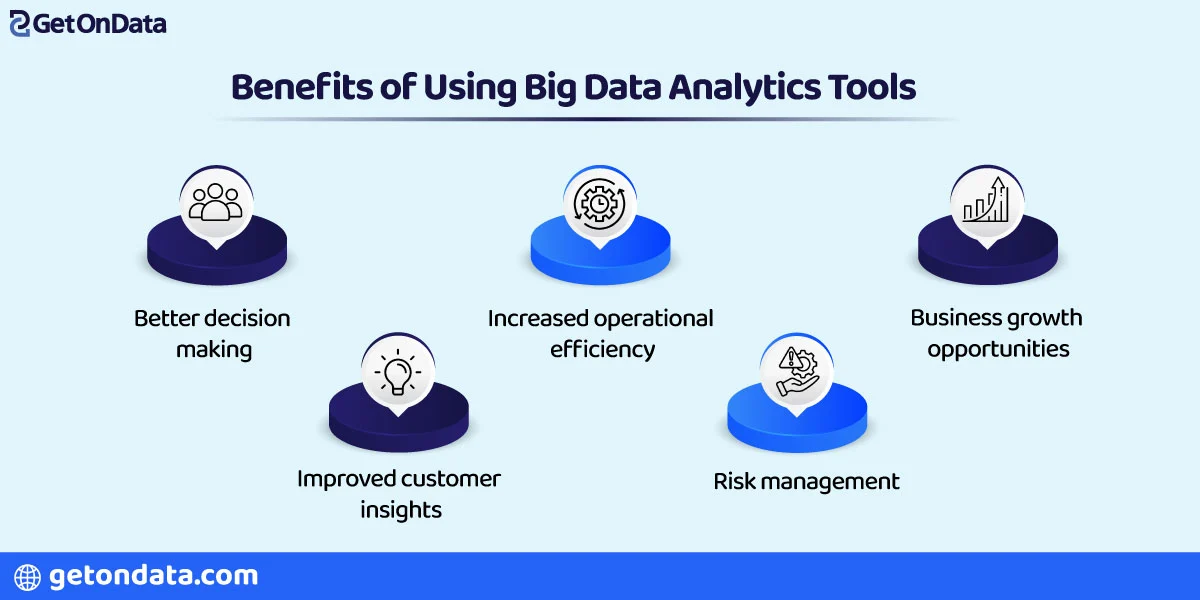
Benefits of Using Big Data Analytics Tools
➥ Better decision-making
The best big data analytics tools allow firms to make smart decisions depending on real-time, accurate data rather than predictions. By measuring datasets, firms can detect trends that encourage building tactics. It can result in on-time, accurate & confident decisions. Data-driven metrics limit uncertainty, drive forecasting accuracy, and support leaders to respond effectively. By using such tools, firms can effectively navigate changing market conditions and challenges with accuracy.
➥ Improved customer insights
By adopting a big data analytics tool, firms can gain a deep understanding of customer behavior, buying patterns, and preferences. By measuring data from various touchpoints, businesses can create a customized experience and target marketing practices. The insights offered by the tool support businesses in enhancing user satisfaction and trust. Understanding user needs accurately allows firms to develop improved products, ultimately drive user engagement, and build future relationships.
➥ Increased operational efficiency
The big data analytics tool supports businesses to streamline inefficiencies & gaps. Firms can optimize resource allocation, automate repetitive tasks, and drive workflow management. It can lead to limited operational costs and improved productivity. By leveraging data insights, businesses can frequently detect performance issues and make improvements. Using big data analytics tools, verify smoother operation & drive resource use throughout the department.
➥ Risk management
The ideal data analytics tools play a strong role in identifying, measuring, and mitigating risks. By measuring historical & real-time data, firms can monitor anomalies, predict potential threats, and take proactive measures. Big data analytics is valuable in areas such as cybersecurity, finance, and compliance. Effective risk management limits loss and drives business continuity. The quality tools support firms to get ready to deal with the uncertain changes in the market.
➥ Business growth opportunities
The top big data analytics tools uncover new growth opportunities by revealing market trends, user demands, and emerging patterns. Firms can identify markets, optimize pricing strategies & innovate products. The insights support strategic expansion & positioning. By leveraging data-driven approaches, firms can drive revenue growth, build market share, and stay current with the data-driven organization landscape.

Choose the Right Big Data Analytics Tool for Smarter Decisions
When it comes to effective data-driven decision-making, having the right big data analytics tool is the key. In the above-discussed topic, we have summarized the data-driven decision-making tools along with their features. Here, we cover everything from the free version tool to paid tools that are accessible for all devices. Business analytics tools are in demand now since they change the way organizations make business decisions through data-driven metrics. Businesses successfully integrate business analytics to derive valuable insights and enhance organizational outcomes.
If you want to leverage success for your business, integrate big data analytics tools. These tools help with the decision-making process to optimize marketing strategies. The tools offer metrics that keep businesses at the forefront in the data-driven landscape. Whether you just start your business or are an expert, a big data analytics tool will always help you achieve your goals. If you want to use any of the tools mentioned above, talk with big data analytics service providers today & book your appointment.

