
In the rapidly moving digital economy, business leaders are pressured to make smarter decisions faster. Nevertheless, lots of organizations fail due to the fact that their data are dispersed, incoherent, or simply unusable. Companies may not realize the data into real business value without having a defined business intelligence implementation roadmap. BI data solutions are vital in this area and can assist organizations that need to organize, analyze, and use the data effectively.
Companies produce colossal volumes of information daily in terms of customer, operational, financial, and marketing information. However, without the right systems such as business data analytics, enterprise big data solutions, and data BI solutions, vast amounts of data can quickly become overwhelming rather than valuable. In fact, 73% of enterprise data goes unused for analytics, limiting business decision-making and growth opportunities. An organized business intelligence implementation strategy will make sure that the data is converted into insights that leaders can rely on and take action.
❑ Why Business Intelligence matters for modern organizations
Business Intelligence (BI) assists organizations in making sense of complex data. Businesses may track performance and trends and make educated decisions with the help of an efficient business intelligence platform. Through tools such as business intelligence data warehousing, and data mining, organizations are able to reveal the patterns that were not visible before.
Intuition is no longer a viable basis for decision-making in modern businesses. Data can be a key driver of strategy for leaders. BI facilitates this change by offering real-time insights into business activities. It enables teams to know what is going on, why it is going on, and what should be done next.
Competitiveness is another important reason why BI is important. Firms that implement enterprise big data solutions have an upper hand since they are able to respond more quickly to market dynamics. They are also able to foresee customer behavior and proactively enhance services.
❑ Common challenges business leaders face
Even with the advantages, most organizations are finding it difficult to implement business intelligence because of a number of challenges:
∘ Information within several systems is not integrated.
∘ Lack of quality data and reporting discrepancies.
∘ Insufficient expertise in corporate data analytics.
∘ Inability to decide on appropriate business intelligence platforms.
∘ Employee resistance to change.
These problems tend to postpone or even block a successful business intelligence implementation. Lack of a proper business intelligence implementation strategy can make businesses invest in tools and not realize the returns.
❑ Key benefits of implementing Business Intelligence
There are several benefits to an efficient business intelligence implementation strategy.
∘ Better decision-making with real-time insights.
∘ Improved data bi solutions in increased operational efficiency.
∘ Enhanced customer knowledge through business intelligence in data mining.
∘ Reduced costs and optimized resource usage.
∘ Improved predictiveness with enterprise big data solutions.
Organizations that hire the services of business intelligence implementation usually achieve quicker outcomes since they adhere to established structures and best practices.
❑ What this implementation roadmap covers
This is a guide talking about step-by-step business intelligence implementation steps. It is concerned with aligning business objectives, evaluating information, choosing tools, creating infrastructure, and adoption. With this roadmap, organizations are likely to have a smooth and successful business intelligence implementation that will provide long-term value.
Define Business Goals and Success Metrics for BI Implementation
❑ Align Business Intelligence with Strategic Business Goals
The first step towards a solid business intelligence implementation plan is clear objectives. Even the most successful enterprise big data solutions will not be able to provide value without clear goals. Organizations should also ensure that these goals are reviewed and revised periodically so that they can be more in tune with the dynamic market environments and business priorities.
⮞ Revenue growth and profitability
Businesses can identify profitable goods, markets, and client segments with the aid of business data analytics. BI tools may be used to monitor trends in revenue and find new opportunities. This will enable leaders to make strategic investment choices and prioritize areas of the business that are doing well.
⮞ Operational efficiency improvements
With data BI solutions, businesses are able to determine the inefficiencies in the processes and minimize costs. BI dashboards give visibility into the operations, enabling teams to optimize workflows. This will, in the long run, result in quicker processes, efficiency in resource use, and better performance in general.
⮞ Customer experience optimization
Business intelligence in data mining can enable businesses to comprehend their customers, their preferences, and their feedback. This raises the degree of client happiness and improves customization. Additionally, businesses can anticipate client requirements and offer more pertinent goods and services.
⮞ Risk mitigation strategies
BI is useful in identifying risks at an early stage through the analysis of patterns and anomalies. Enterprise big data solutions are able to detect fraud, operational risks, and compliance issues. This preventive strategy helps companies reduce losses and stay afloat in volatile environments.
❑ Identify Key Stakeholders Across Business Departments
Collaboration inside the company is essential for a successful business intelligence deployment. Effective communication between stakeholders will make implementation easier and increase the success rate.
⮩ Executive leadership
The vision is expressed by executives, who also ensure that it is in line with corporate strategy. Without their assistance, a business intelligence installation cannot be successful. They also contribute to pushing organizational commitment and the acquisition of requisite resources.
⮩ Department heads
They give feedback on the particular business requirement and make BI consistent with departmental objectives. They are involved in customizing solutions that bring actual value to every function.
⮩ IT and analytics teams
These teams deal with the technical issues of the business intelligence data warehousing, system integration, and security of data. Additionally, they guarantee the infrastructure’s performance and scalability.
⮩ Business users
A business intelligence platform is interacted with by end users on a daily basis. Their comments are essential to adoption and success. Early involvement assists in making the solution easier to use and guarantees that the solution will be in line with actual business needs.
❑ Define Measurable KPIs to Track BI Implementation Success
Monitoring KPIs can help make sure that your business intelligence implementation roadmap provides quantifiable outcomes. Periodic checks of these metrics ensure that organizations are on track and can make the required improvements.
⮞ Financial performance metrics
Increase in revenues, profitability, and reduction of costs. These measures are direct financial effects of the business intelligence implementation solutions.
⮞ Operational efficiency metrics
Turnaround time, process improvements, and productivity. These indicators outline the effectiveness of business processes optimization.
⮞ Customer-related performance metrics
Retention, satisfaction, and engagement rates. These insights are used to help gauge the satisfaction of customers with the organization.
These indicators can be used to measure the success of the business intelligence implementation solutions and facilitate ongoing enhancements.

Assess Current Data Infrastructure and Analytics Capabilities
❑ Evaluate Existing Data Sources Across Business Systems
Before implementing BI, organizations must understand their current data environment. A clear evaluation will be used to determine the strengths, weaknesses, and areas to improve in the current data ecosystem.
⮩ CRM platforms
Offer customer information and sales. They can also assist in tracking customer interactions and enhancing relationship management strategies.
⮩ ERP systems
Provide operating and financial information. These systems guarantee improved communication among the business functions.
⮩ Marketing automation tools
Monitor the campaign performance and customer interaction. They offer practical information on effectiveness and ROI in marketing.
⮩ Financial systems
Present proper revenue and cost information. This information can be used in budgeting, forecasting, and financial planning.
Putting together these sources through enterprise big data solutions will guarantee a single picture of the business. This integration creates an opportunity to make decisions and report more accurately.
❑ Identify Data Gaps and Organizational Data Silos
Any business intelligence platform is constrained by a fragmented data environment. Early detection of these gaps assists organizations in creating a more efficient and well-connected data system.
⮞ Disconnected systems
Non-communicating systems form incomplete understandings. This results in inefficiency and delays in making decisions.
⮞ Missing data sources
Data that is critical might not be captured and stored. Consequently, companies can fail to capture important insights and opportunities.
⮞ Inconsistent data definitions
Data can be viewed differently by different teams. This brings about confusion and lessens trust in reports.
These problems make BI data solutions less effective and impede effective business intelligence implementation. It is necessary to tackle them to establish a trustworthy analytics base.
❑ Review Data Quality and Governance Challenges
Effective BI is based on high-quality data. Information that is accurate, secure, and usable across the enterprise is ensured by good governance.
⮩ Data accuracy
Verify that the data is accurate and free of errors. Quality data results in more credible knowledge and improved judgments.
⮩ Data completeness
Fill in the blanks to enhance understanding. A more complete picture of corporate performance is provided by complete data.
⮩ Data consistency
Normalize formats and definitions. Uniformity will promote the reliability of information within every department.
Good governance helps in business intelligence data warehousing and guarantees good analytics. It is also useful in assisting organizations to be compliant and minimize risks.
Also Read: Top business intelligence company in Dubai delivering scalable BI solutions
Select the Right Business Intelligence Tools and Platforms
❑ Key Criteria for Selecting Business Intelligence Tools
Making the appropriate selection of tools is paramount to your business intelligence implementation roadmap. The correct choice guarantees success in the long term and easy integration throughout the organization.
⮞ Scalability and flexibility
The future growth and enterprise big data solutions should be supported with tools. This enables companies to grow without the need to frequently change their systems.
⮞ Portability and usability
Easy-to-use tools enhance adoption and productivity. Easy interfaces allow the teams to learn to use the system within a brief time.
⮞ Integration capabilities
The tools should be compatible with other systems. The seamless integration will guarantee the smoothness of the data flow and decrease the amount of manual work.
⮞ Cost and cost-effectiveness
Evaluate value and ROI in the long run. Companies need to prioritize those tools that provide a quantifiable payoff in the long run.
❑ Compare Leading Business Intelligence Platforms
⮩ Microsoft Power BI: A user-friendly tool that is highly integrated with Microsoft and has robust reporting.
⮩ Tableau: Offers more sophisticated and dynamic data visualization.
⮩ Looker: Visualization of real-time data in the cloud.
⮩ Qlik: A dynamic tool that allows exploring data at will and discovering insights.
These platforms promote advanced business data analytics and data BI solutions. All of the platforms have their peculiarities, and the choice of the appropriate platform lies with the needs and purposes of the business.
❑ Evaluate Cloud Versus On-Premise Deployment Options
⮞ Security requirements
Secure valuable business information. Companies need to select solutions that comply with and address security standards.
⮞ Infrastructure needs
Cloud solutions save on hardware expenses. They are also flexible and easier to manage systems.
⮞ Budget considerations
Select business intelligence implementation services at low costs. It is essential to strike a balance between initial expenditures, continuing upkeep, and scalability.
Build a Scalable Data Architecture and Governance Framework
❑ Design Data Warehouse and Data Integration Architecture
Business intelligence implementation requires a solid database. It also makes all the data structured, available, and ready for analysis.
⮩ Data warehouse implementation
Use business intelligence data warehousing to centralize data. This enables businesses to have one source of truth to make improved decisions.
⮩ Data lakes and data pipelines
Store and manipulate high amounts of data. They facilitate dealing with both structured and unstructured data as well.
⮩ Integration strategies
Make sure that there is a smooth flow of data between systems. Good integration will minimize duplication and enhance the accuracy of data.
❑ Establish Data Governance Policies and Ownership Models
⮞ Ownership and accountability of data
Create a data management responsibility. The explicit ownership of data aids in the quality and accountability of data within teams.
⮞ Data standards and definitions
Make sure there is uniformity between teams. Standard definitions minimize confusion and enhance the accuracy of reporting.
⮞ Security and compliance
Protect data and meet regulations. Effective policies assist in avoiding data breaches and legal compliance.
❑ Plan Scalable Architecture for Future Business Growth
⮩ Flexible infrastructure
Keep up with business demands. This is flexible and promotes innovation and changing business demands.
⮩ Performance optimization
Process massive volumes of data more quickly. Optimized systems enhance user experience and speed of decision-making.
⮩ Long-term scalability
Promote the expansion of enterprise big data solutions. Scalable architecture will allow the system to support growing amounts of data without any problems with performance.
Design Business Intelligence Dashboards and Reporting Strategy
❑ Identify Reporting Requirements for Business Leaders
⮞ Executive dashboards
Offer top-level information to make decisions. They assist leaders in knowing about business performance and trends quickly.
⮞ Operational dashboards
Measure performance metrics on a daily basis. These dashboards aid real-time tracking and rapid operation choices.
⮞ Department-specific reports
Provide specific guidance to the teams. This will make all departments receive relevant and actionable information.
❑ Apply Dashboard Design Best Practices for Usability
⮩ Clear visualizations: Simple charts and graphs. Data is easily understood and interpreted using clear visuals.
⮩ Actionable insights: Concentrate on decisions, not on data. Dashboards are supposed to lead users to actions that are meaningful.
⮩ Minimal design complexity: Eliminate confusion and clutter. A clean design enhances user adoption and experience.
Dashboards are quicker and more dependable using business intelligence data warehousing. This guarantees stable performance despite big data.
❑ Test and Validate Reports Before Deployment
⮞ User testing: Ensure usability and adoption. User feedback aids in the enhancement of the overall experience.
⮞ Data validation: Check the validity of insights. Correct information develops confidence in the system.
⮞ Performance testing: Ensure speed and reliability. Effective performance means that users will not be delayed in insights.
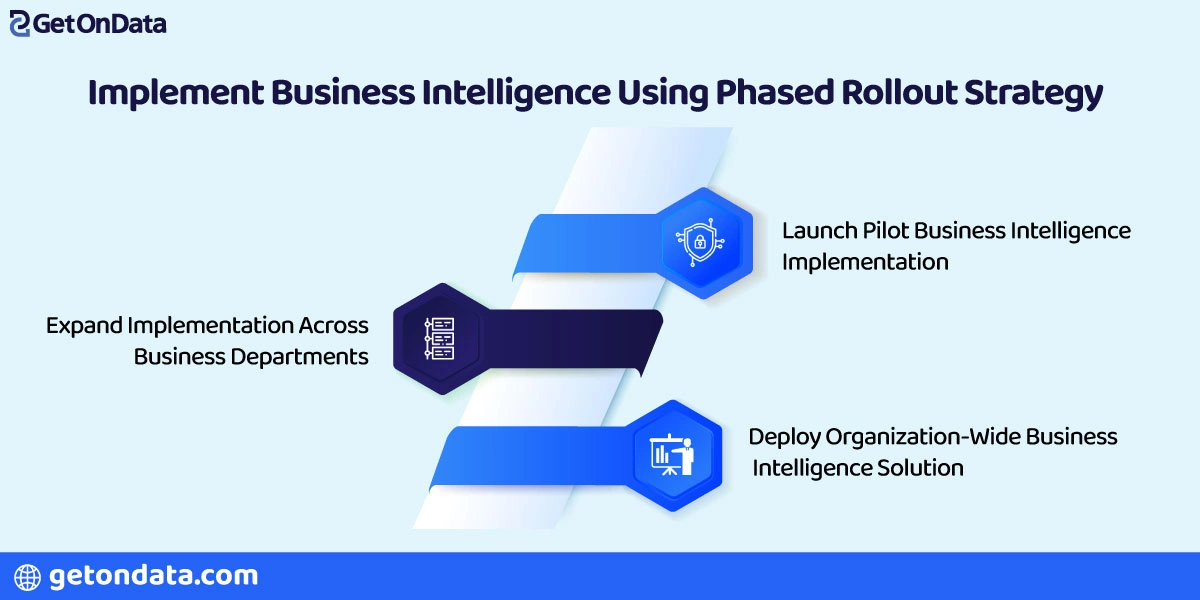
Implement Business Intelligence Using a Phased Rollout Strategy
❑ Launch Pilot Business Intelligence Implementation
Begin with a pilot in order to implement business intelligence successfully. It minimizes risk and aids in testing the overall strategy prior to its implementation on a large scale.
⮩ Choose high-impact use cases.
Look at areas of quick wins. Such initial successes aid in the creation of confidence and value.
⮩ Test dashboards
Validate insights and usability. Testing helps to make sure that the dashboards are effective in fulfilling the business needs.
⮩ Gather user feedback
Improve system performance. Feedback assists in perfecting features and improving the user experience.
❑ Expand Implementation Across Business Departments
⮞ Gradual department rollout: Avoid overwhelming users. A gradual implementation will enable the teams to change more comfortably.
⮞ Stakeholder engagement: Encourage collaboration. Being active means a more accurate alignment and an easier adoption.
⮞ Adoption planning: Provide training to users of the business intelligence platform. When well trained, the use is more beneficial.
❑ Deploy Organization-Wide Business Intelligence Solution
⮩ Standardized dashboards: Ensure that teams are consistent. The standardization enhances clarity and decision-making.
⮩ Governance enforcement: Maintain data quality. Good governance will provide good and precise insights.
⮩ Performance monitoring: Track system effectiveness. Constant observation is used to determine areas of improvement and optimization.
Also Read: Top business intelligence company in Dubai delivering scalable BI solutions
Measure Performance and Optimize BI Implementation Continuously
❑ Track Key Metrics for Business Intelligence Success
⮞ ROI and business impact
Measure financial outcomes. This can be used to find out whether the business intelligence implementation is producing real value.
⮞ Adoption rate
Track user engagement. The high adoption means that the business intelligence platform is successfully assisting users.
⮞ Decision-making efficiency
Evaluate speed and accuracy. The success of business data analytics initiatives is shown by faster and better decisions.
❑ Continuously Improve Dashboards and Data Models
⮩ Create new sources of data
Expand analytics capabilities. And This enables companies to have a better and more in-depth insight.
⮩ Improve visualizations
Increase usability and clarity. And Enhanced graphics enable users to comprehend data faster and more precisely.
⮩ Optimize performance
Ensure system efficiency. And Constant optimization ensures that the system remains quick and dependable with the increase in data.
❑ Scale Toward Advanced Analytics and AI Capabilities
⮞ Predictive analytics
∘ Make business predictions through analytics.
∘ This allows proactive decision-making and planning.
⮞ AI-driven insights
∘ Automate decision-making processes.
∘ AI assists in detecting trends that might not be apparent when analyzed manually.
⮞ Automation and alerts
∘ Improve response times.
∘ Automated notices will make sure that any essential changes are handled in real-time.
These measures enhance the business intelligence implementation solutions and ensure long-term success. Continuous improvement keeps organizations competitive and helps them to get the best value out of their investments in BI.

Ready to Turn Data into Decisions and Lead with Confidence
The clearly outlined business intelligence implementation roadmap enables organizations to transform raw and complicated data into precise and actionable information that can be used in making confident and timely decisions. With a systematic approach to business intelligence implementation steps, businesses can transcend the guesswork and have a successful business intelligence implementation that can produce measurable outcomes.
In order to ensure that this occurs, leaders should align the BI initiatives with the strategic business objectives, invest in a scalable and reliable business intelligence platform, and emphasize the quality of data and governance systems. Implementing flexible enterprise big data systems will guarantee that the systems have the capability to expand with the business, whilst maintaining high performance. Meanwhile, optimization and innovation should be constant, and new markets require quicker insights and more intelligent decisions.
Through the strength of business intelligence in data mining, it is possible to uncover the hidden trends, forecast trends, and reveal new growth opportunities that would not have been realized otherwise. The next step should be to develop a well-defined business intelligence implementation plan, evaluate their existing data infrastructure, and select the appropriate tools and technologies that suit their objectives.
The use of professional business intelligence implementation services may also accelerate the process and minimize risks, whereas a high emphasis on user adoption and training will provide teams with the ability to efficiently utilize data BI solutions and business data analytics capacities in their day-to-day work. Ultimately, with the constant enhancement of the business intelligence implementation solution, scaling of their systems, and innovation, organizations will be in a better position to be data-driven, competitive, and increase their growth in a sustainable manner.

