
By 2026, Power BI trends are transforming the way organizations derive value from their data. The use of data-driven decision-making is presently not a superior gain, but rather a commercial requirement.
Power BI ranks among the foremost corporate understanding tools that allow firms to transform unprocessed figures into meaningful observations. The platform offered by Microsoft has developed much more than just static dashboards and simple charts. It currently provides AI-based analytics, real-time stream, and cloud integration.
The platform is updated monthly, bringing in new features and abilities. Organizations that keep abreast with the trends in Power BI have quicker insights, minimize manual examination time, and make superior choices.
Power BI consulting services enable companies to adjust to these swift changes and execute solutions that can deliver quantifiable outcomes. The appropriate consulting partner will see your organization achieve the best possible Power BI trends 2025 without falling into the usual implementation traps.
Evolving Role of Power BI in 2026
☢ Shift Toward Real-Time Analytics
Real-time analytics is not merely an extra benefit; it stands as a fundamental attribute. Power BI has become fully compatible with streaming data sources, which allows businesses to display the data as it passes through their systems.
The growth of streaming data towards live dashboards is an indication of evolving business demands. Markets are more dynamic than ever, and enterprises risk forfeiting substantial funds by acting upon the previous day’s statistics. The streaming data feature of Power BI enables organizations to handle thousands of events per second so that the results are shown immediately in interactive dashboards.
Integration with IoT and real-time data pipelines has expanded dramatically. Manufacturing plants feed sensor data directly to Power BI, where they track the performance of equipment on a second-by-second basis. Retailers monitor the inventory of thousands of stores at once. Banks identify fraudulent activities in milliseconds after they take place.
In 2023, the data pipeline market is estimated at 8.22 billion globally and is expected to grow to 33.87 billion by 2030, representing a compound annual growth rate of 22.4%. This expansion indicates that companies continue to rely heavily on instantaneous information management.
Retailers will be able to monitor dynamic inventory flows and set prices. Manufacturers also observe the production lines at all times, and they recognize bottlenecks even before they can affect output. Customers lose less, and banks mitigate fraud immediately. This transformation of the lifeless reports into a live dashboard is redefining business agility.
☢ Increased Democratization of Data
Self-service BI is spreading across the departments, shattering the traditional walls that limited access to data to specialized teams. By 2026, workers across every tier of the organization will use trends in Power BI without having to rely on IT services.
Improved end-user interfaces allow users who are not technical to generate complex visualizations. The drag-and-drop feature enables marketing managers to create customer segmentation reports. Production tracking dashboards are designed by operations supervisors without any code. Budget variance reports are prepared by financial analysts on their own.
This widespread availability alters the attitude of a firm. Instead of locking up company data in departmental silos, the companies are sharing information freely. Sales departments gain the same customer insights as the service departments. Product managers see manufacturing information together with market research. This openness facilitates decision-making and ensures cooperation.
Studies indicate that two-thirds of those in high-performing organizations, on average, say that data is available throughout the organization, versus only a third in low-performing organizations. Power BI database consulting assists organizations in developing governance models that are both accessible and secure. The disparity between data-driven businesses and their rivals is growing larger.

Key Power BI Trends in 2026 Driving Faster Insights
☢ AI-Powered Analytics & Copilot Integration
Microsoft has integrated Copilot into Power BI, and it has radically transformed the way people work with data. This artificial intelligence helper helps to make reports, create dashboards, and even generate queries in DAX through natural language.
Just ask Power BI to show you the growth of sales per region on a quarterly basis, and you will have a polished visualization immediately. This will remove the technical barrier that once denied business users access to insights. Teams use less time to understand sophisticated tools and more time to analyze the findings.
The use of natural language queries with the help of AI simplifies the reporting process considerably. Copilot transforms plain English requests from the users into relevant visualizations. This implies accelerated report generation without technical skills.
Predictive analytics and automated insights represent another breakthrough. The AI in Power BI has evolved to go beyond descriptive analytics to forecasting based on future results. Businesses can forecast the shifts in demand, the churn of customers, and optimize supply chains with in-built machine learning models.
Power BI database consulting can assist organizations in setting these AI features properly, and the models can be trained with good-quality data and provide proper predictions.
The smart narrative visuals are able to summarize trends automatically, and this feature provides context to dashboards without human input. These summaries, which are generated by AI, draw important conclusions, clarify abnormalities, and propose spheres of interest. Executives read such stories and interpret business performance within seconds, as opposed to hours.
☢ Advanced Data Modeling with Fabric Integration
Microsoft Fabric is a breakthrough in enterprise analytics architecture. This platform consolidation integrates Power BI, Data Factory, Synapse, and OneLake in one AI-ready platform.
A closer coordination with the Microsoft Fabric will introduce integrated data experiences throughout the organization. Teams do not have to deal with disconnected tools and incompatible formats. All this is linked with a mutual database that guarantees uniformity and dependability.
In October 2025, Fabric became even stronger, with the introduction of a new feature, Outbound Access Protection of Spark, and Data Agent connectivity in Lakehouse, as well as a wider range of file formats in Data Factory. Fabric also provides the ability to manage and analyze data more quickly and safely than ever before, with more than 150 connectors, serverless compute, and built-in governance with Microsoft Purview.
It has become clear that the performance of complex data modeling and transformation has improved. Earlier adopters such as the IFS and the London Stock Exchange Group had reported notable productivity and analytics efficiency. Microsoft stated that by using Fabric, enterprises improved by up to 40% in data accessibility and 30% in integration costs.
Power BI consulting companies focus on Fabric implementation, which assists companies in moving their old systems and developing the best practices that make the most out of the platform.
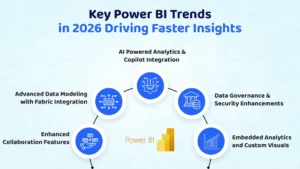
☢ Enhanced Collaboration Features
The combination of Microsoft’s Power BI software and its collaboration tool has grown much stronger. Users can also share dashboards, share insights, and make decisions without leaving their collaboration workspace. The reports integrate directly into Teams channels so that all the people can see the same up-to-date data.
Shared datasets eliminate overlapping work in different departments. Instead of developing multiple instances of the identical customer database, teams use one certified dataset. It is a good method to maintain uniformity at a lower cost of storage and maintenance overhead.
Real-time co-authoring allows several analysts to work together on the same report at the same time. This team style also enables faster project cycles and better quality in output because of instant feedback.
Also read :- Top-Rated Power BI Partners in India Offering End-to-End BI Solutions
☢ Embedded Analytics and Custom Visuals
Power BI Embedded enables companies to incorporate analytics into applications that engage customers. Vendors do not develop analytics infrastructure but rather add reporting features to their software. This produces smooth experiences in which users can find insights in the workflows they already have.
The increase in industry-specific custom images caters to niche requirements in industries. Patient journey visualizations are used by healthcare organizations. Financial service companies use tailored risk assessment charts. Retailers use sophisticated promotional images. These domain-specific features make Power BI more domain-specific.
☢ Data Governance & Security Enhancements
As the number of organizations using Power BI has increased, data governance has come into the limelight. Role-based security signifies that people can only view facts that are pertinent to their assignments and responsibilities. Finance information is confined to finance departments, but sales data is widely available.
Data lineage and sensitivity labeling with Purview integration provide transparency into data origins and usage. Administrators trace the reliance of particular reports on a particular dataset, understand the downstream effects of any changes, and maintain the regulation of data such as GDPR and HIPAA.
In 2026, ownership and lineage tracking take center stage. Good ownership labels, usage history, and certification labels assist a team in distinguishing between tested and trial assets. Such an organization minimizes confusion and enhances trust in organizational information.
These enhancements in governance are particularly advantageous in Power BI consulting for financial analytics. This occurs since money management businesses are bound by strict supervising requirements concerning information protection and auditability.
The new level of data discovery in Power BI is metadata. The metadata is structured to allow users to navigate datasets by using wizards like refresh schedules, related reports, sensitivity labels, and business-related terms. The methodology will minimize reliance on tribal knowledge. New staff members will be able to locate the required information without lengthy training.
Industry Applications and Use Cases
● Retail
Retailers use Power BI future trends to revolutionize inventory control and customer experience. Inventory tracking in real time prevents stockouts and minimizes surplus stock, which is a capital tie-up. Research indicates that contemporary retail demand forecasting saves 20-35 percent of inventory expenses and eliminates 65 percent of stockouts using AI-driven forecasts.
Demand forecasting applications consider past trends in sales, weather trends, social media trends, and economic trends. In 48 hours, a TikTok trend can lead to 300 percent surges in demand and vanish entirely. This volatility is impossible to forecast using traditional techniques, but Power BI solutions that use AI will adjust dynamically.
The AI-driven demand forecasting system developed by Walmart takes into consideration weather patterns, historical sales data, and the local population in the area to position holiday products in 4,700 stores. The outcome is a 15% reduction in out-of-stocks during the peak times and a major increase in customer satisfaction ratings.
● Healthcare
Power BI enables healthcare organizations to develop patient data dashboards that have secure role-based access. Clinical dashboards are used to give extensive views of the results of treatment, monitoring of infections, and patient metrics. The tools monitor recovery rates, readmissions, and mortality rates to provide healthcare providers with real-time snapshots of clinical effectiveness.
Instead of using periodic data sets to monitor patient vitals, hospitals are now using continuous streams of data to identify warning signs before they worsen. Care teams are responding more proactively and efficiently, with better outcomes and fewer interventions for emergencies.
Operational dashboards track the effectiveness of workers, including employee-to-consumer metrics, quantity of bookings, mean duration per activity, and training completion rates. The level of inventory and supplier lead times are observed, and the supply chain management dashboards allow the facilities to prevent stockouts and save costs.
Power BI dashboard consultant designs these healthcare solutions and makes sure they are not against HIPAA regulations. These provide convenient interfaces that can be easily used by busy medical personnel.
● Manufacturing
IoT sensor data visualized in Power BI is used by manufacturing facilities to perform predictive maintenance. The global manufacturing predictive analytics market will have hit 1,604.0 million dollars in 2024 and will grow at 16.2% to total $6,617.4 million by 2033.
Conventional production is reactive- devices fail, factories come to a halt, groups rush to make repairs, and profits are lost. Studies indicate that ineffective maintenance strategies may decrease the productive capacity of a plant by 5-20 percent. Typically, the average manufacturer experiences about 800 hours of unexpected machine upkeep and downtime every year.
IoT sensors are used to constantly check the condition of equipment, analyzing vibrations and temperature variations, acoustic indicators, and performance degradation. Machine learning solutions utilize these patterns and predict breakdowns several days or seven-day periods prior to their occurrence. Manufacturers who have adopted predictive maintenance systems have reported that machine downtime is reduced by 30-50 percent and that maintenance costs are reduced by 10-40 percent.
By implementing quality control analytics, inspection goes beyond reactive testing to preventive measures. The adoption of predictive quality analytics by Bosch in its automotive component production cut customer complaints by 90 percent. In their system, thousands of parameters of processes are monitored in real-time, indicating anomalies that would otherwise go unnoticed by human operators.
Also read :- Power BI Consulting Services for Every Stage of Your BI Journey
● Financial Services
Financial institutions engage Power BI consulting for financial analytics to develop advanced fraud detectors with the help of AI-based anomaly detection. Banks and fintechs use streaming data to prevent fraud and deliver personalized services, among other applications.
Algorithms at PayPal enhanced real-time fraud detection by 10 percent, keeping the company at the top of the industry with a 0.17 percent fraud rate. Billions of transactions are handled through the Decision Intelligence platform of Mastercard, which reduces false alerts by 200 percent and detects actual fraud.
In the year 2025, Mastercard went through 160 billion transactions in just under a millisecond. It led to a reduction in inaccurate repudiation and customer experiences. It also saved millions of dollars in review charges and reinstated valid transactions that would otherwise be rejected.
Q2 Holdings introduced an artificial intelligence-based service known as Enhanced Payee Match that has not only tripled the rate of fraud detection but has also reduced false positives by around 80 percent. A Power BI dashboard consultant has saved millions of dollars in potential fraud claims and cut customer complaints.
Risk management dashboards enable real-time analysis of credit risk and review of portfolio performance. These tools are directly managed by analysts who can react quickly to market shifts. They develop proactive risk management programs through self-service capabilities.
Preparing for the Future: How Companies Can Stay Ahead
In order to get the most out of Power BI trends 2025, organizations must invest in training and data culture. Technical expertise matters, but culture shift facilitates long-term change.
Using Power BI Premium or Fabric in scalable analytics is a prudent purchase. These platforms are scaled to deal with data volumes at an enterprise level. They guarantee steady response periods irrespective of peaks in use.
Power BI consulting for financial analytics supports corporations in achieving the ideal equilibrium amidst expenditure and efficiency requirements and growth predictions. Marketing campaign data should be available to sales teams. Customer service metrics should be viewed by product teams. Finance must be aware of the operational aspects to enhance the results.
Using AI features reduces manual data analysis time dramatically. Instead of consuming numerous hours constructing documents, reviewers concentrate on explaining outcomes and suggesting measures. A copilot handles routine tasks while humans apply judgment and creativity.
Organizations should establish governance frameworks before expanding Power BI usage. Clear policies around data ownership, certification processes, and security protocols prevent chaos as adoption scales. Metadata standards and documentation practices ensure new users can navigate existing assets efficiently.

Ready to Turn Data into Decisions? Let’s Talk Power BI.
Power BI is becoming faster, smarter, and more accessible in 2026. AI-powered features like Copilot remove specialized obstacles, allowing commercial personnel to create understanding autonomously. Fabric integration creates unified data experiences that improve consistency and reduce complexity.
Self-service BI tools authorize workers at all seniority levels to view figures and implement educated choices. Enhanced collaboration features break down silos and foster cross-functional teamwork. Embedded analytics bring insights directly into operational workflows where they drive immediate action.
Power BI consulting companies bring expertise in governance frameworks, Fabric implementation, AI configuration, and change management. They accelerate time-to-value while avoiding common implementation pitfalls.
Technologies evolve rapidly, and competitive advantages erode quickly. Organizations that embrace Power BI trends gain advantages that compound over time. Those who delay risk falling permanently behind more agile competitors.
Companies should explore new Power BI capabilities actively rather than waiting for perfection. Build momentum through quick wins that generate executive support. Scale gradually while maintaining governance and quality standards.
The Power BI future trends direct attention toward still higher cleverness, availability, and unity. Success requires commitment to data culture, investment in skills development, and willingness to challenge traditional ways of working. Organizations that combine Power BI consulting services with internal capability building position themselves for sustained success.

